22 select the correct answer. consider function f. f(x) = { 2^x, x < 0 -x^2 - 4x + 1, 0 < x < 2 1/2x + 3, x…
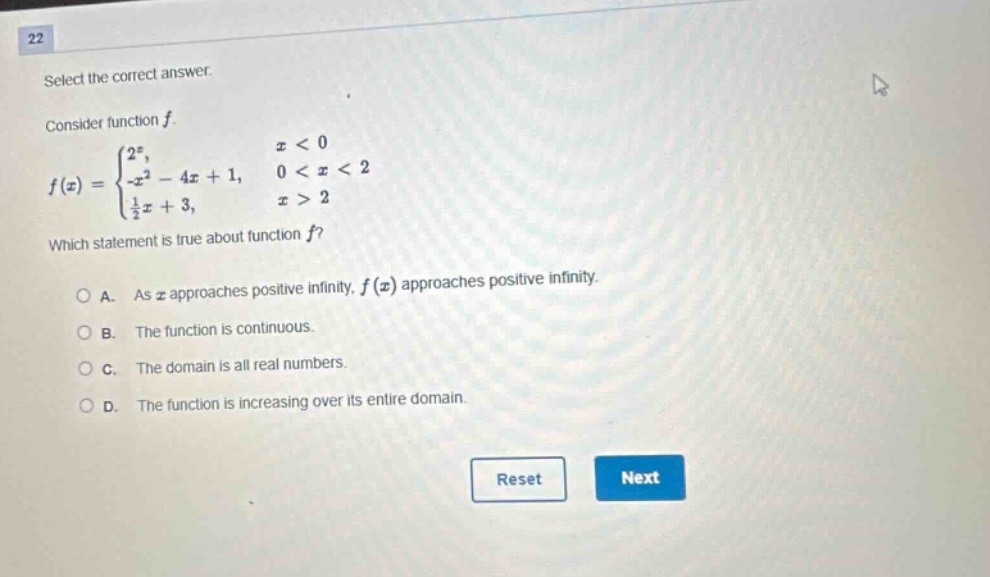
22 select the correct answer. consider function f. f(x) = { 2^x, x < 0 -x^2 - 4x + 1, 0 < x < 2 1/2x + 3, x > 2 which statement is true about function f? a. as x approaches positive infinity, f(x) approaches positive infinity. b. the function is continuous. c. the domain is all real numbers. d. the function is increasing over its entire domain. reset next
Answer
Answer:
C. The domain is all real numbers.
Explanation:
Step1: Analyze domain of each part
For (y = 2^{x}), (x<0); for (y=-x^{2}-4x + 1), (0 < x<2); for (y=\frac{1}{2}x + 3), (x>2). The union of (x<0), (0 < x<2) and (x>2) along with the non - defined points (x = 0) and (x=2) gives all real numbers as the domain.
Step2: Analyze option A
As (x\rightarrow+\infty), (f(x)=\frac{1}{2}x + 3), which approaches (+\infty), but we need to consider the whole function behavior. For (0 < x<2), (y=-x^{2}-4x + 1) is a downward - opening parabola, so the statement "As (x) approaches positive infinity, (f(x)) approaches positive infinity" is not a comprehensive description of the whole function.
Step3: Analyze option B
Check continuity at (x = 0) and (x=2). At (x = 0), (\lim_{x\rightarrow0^{-}}2^{x}=1), (\lim_{x\rightarrow0^{+}}-x^{2}-4x + 1 = 1). At (x = 2), (\lim_{x\rightarrow2^{-}}-x^{2}-4x + 1=-4 - 8+1=-11), (\lim_{x\rightarrow2^{+}}\frac{1}{2}x + 3=1 + 3=4). The function is not continuous.
Step4: Analyze option D
The function (y=-x^{2}-4x + 1) for (0 < x<2) is a downward - opening parabola ((y=-(x + 2)^{2}+5)), so it is decreasing on part of its sub - domain, and the function is not increasing over its entire domain.