22. sketch a graph of the function $g$ given by $g(\theta)=3cos(\theta + pi)$. \n23. describe how the graph…
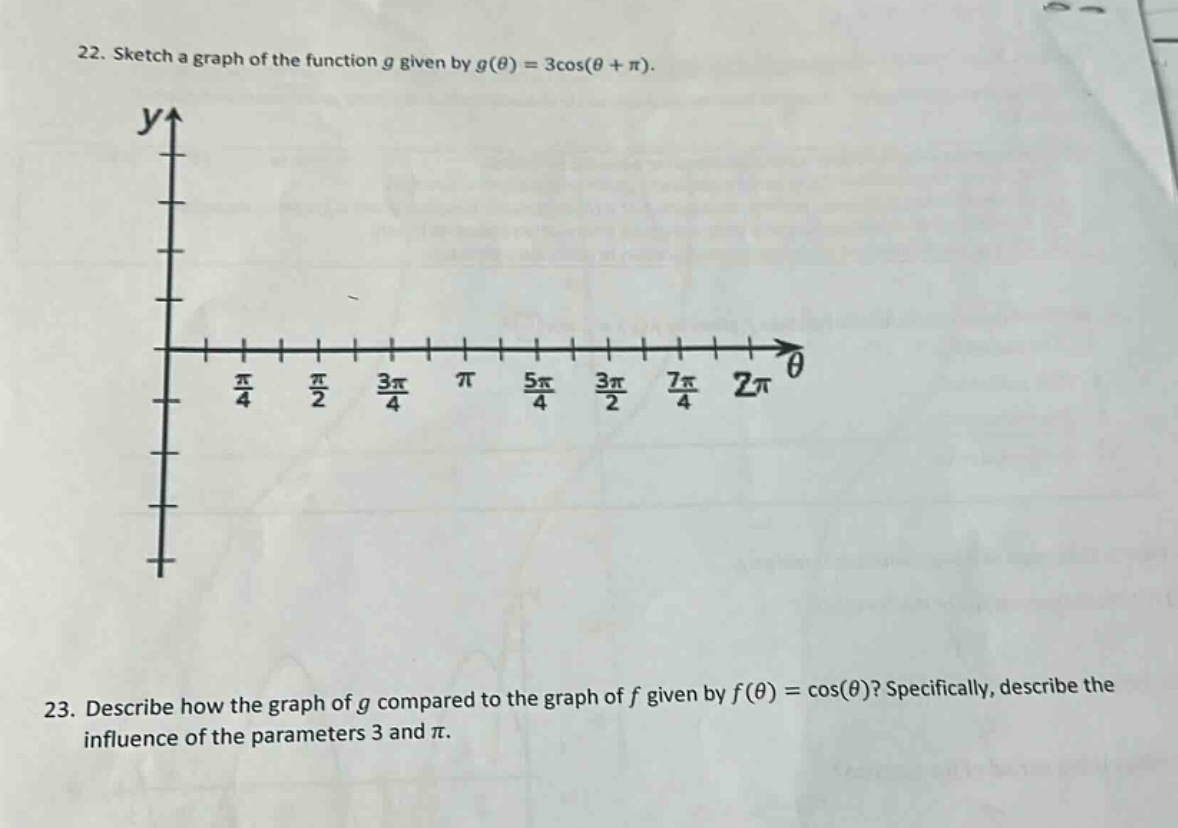
22. sketch a graph of the function $g$ given by $g(\theta)=3cos(\theta + pi)$. \n23. describe how the graph of $g$ compared to the graph of $f$ given by $f(\theta)=cos(\theta)$? specifically, describe the influence of the parameters 3 and $pi$.
Answer
Explanation:
Step1: Recall cosine - function properties
The general form of a cosine function is $y = A\cos(B(\theta - C))+D$. For $g(\theta)=3\cos(\theta+\pi)$, $A = 3$, $B = 1$, $C=-\pi$, $D = 0$.
Step2: Analyze the amplitude
The amplitude of the cosine function $y = A\cos(B(\theta - C))+D$ is given by $|A|$. Here, $A = 3$, so the amplitude of $g(\theta)$ is $3$. The standard cosine function $y=\cos(\theta)$ has an amplitude of $1$.
Step3: Analyze the phase - shift
The phase - shift of the cosine function $y = A\cos(B(\theta - C))+D$ is given by $C$. For $g(\theta)=3\cos(\theta+\pi)=3\cos(1\times(\theta-(-\pi)))$, the phase - shift is $-\pi$. This means the graph of $y = \cos(\theta)$ is shifted $\pi$ units to the left.
Step4: Sketch the graph
- First, consider the key points of the standard cosine function $y=\cos(\theta)$:
- The period of $y = \cos(\theta)$ is $T = 2\pi$. For $y = 3\cos(\theta+\pi)$, the period is also $T=\frac{2\pi}{|B|}=\frac{2\pi}{1}=2\pi$ since $B = 1$.
- The key points of $y=\cos(\theta)$ are $(\theta,y)$: $(0,1),(\frac{\pi}{2},0),(\pi, - 1),(\frac{3\pi}{2},0),(2\pi,1)$.
- For $y = 3\cos(\theta+\pi)$, when $\theta=-\pi$, $y = 3\cos(0)=3$; when $\theta=-\frac{\pi}{2}$, $y = 3\cos(\frac{\pi}{2}) = 0$; when $\theta=0$, $y = 3\cos(\pi)=-3$; when $\theta=\frac{\pi}{2}$, $y = 3\cos(\frac{3\pi}{2}) = 0$; when $\theta=\pi$, $y = 3\cos(2\pi)=3$.
- Plot these key - points on the given $\theta - y$ axes and draw a smooth cosine - like curve.
Answer for 22:
Sketch a cosine - like curve with amplitude 3 and phase - shift $\pi$ units to the left of the standard cosine curve.
Explanation for 23:
The parameter $A = 3$ in $g(\theta)=3\cos(\theta+\pi)$ stretches the graph of $f(\theta)=\cos(\theta)$ vertically by a factor of 3. The parameter $\pi$ (the phase - shift $C =-\pi$) shifts the graph of $f(\theta)=\cos(\theta)$ $\pi$ units to the left.
Answer for 23:
The graph of $g(\theta)$ has an amplitude 3 times that of $f(\theta)$ (vertical stretch by a factor of 3) and is shifted $\pi$ units to the left compared to the graph of $f(\theta)$.