23. $y = 2^{\tan^{2}(x^{2}+1)}$\n24. $y = e^{1/ln(x^{2})}$\n25. $y = e^{ln(sqrt{x + 1})^{2}}$
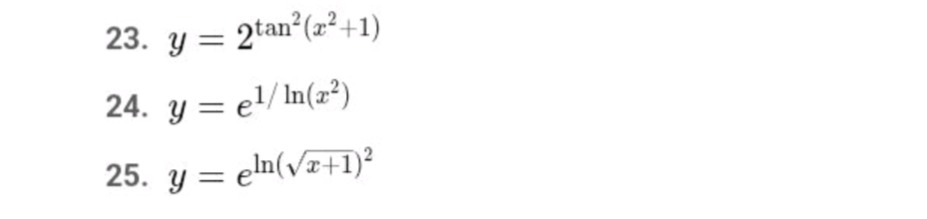
23. $y = 2^{\tan^{2}(x^{2}+1)}$\n24. $y = e^{1/ln(x^{2})}$\n25. $y = e^{ln(sqrt{x + 1})^{2}}$
Answer
- For (y = 2^{\tan^{2}(x^{2}+1)}):
- Step 1: Use the chain - rule and the formula for the derivative of (a^{u}) ((a>0,a\neq1))
- The derivative of (y = a^{u}) with respect to (x) is (y^\prime=a^{u}\ln a\cdot u^\prime). Here (a = 2) and (u=\tan^{2}(x^{2}+1)). So (y^\prime=2^{\tan^{2}(x^{2}+1)}\ln 2\cdot\frac{d}{dx}(\tan^{2}(x^{2}+1))).
- Step 2: Use the chain - rule again for (\frac{d}{dx}(\tan^{2}(x^{2}+1)))
- Let (v=\tan(x^{2}+1)), so (\tan^{2}(x^{2}+1)=v^{2}). The derivative of (v^{2}) with respect to (x) is (2v\cdot v^\prime). Now (v = \tan(x^{2}+1)), and by the chain - rule, (v^\prime=\sec^{2}(x^{2}+1)\cdot\frac{d}{dx}(x^{2}+1)).
- Step 3: Differentiate (x^{2}+1)
- (\frac{d}{dx}(x^{2}+1)=2x).
- Combining all the steps, (y^\prime=2^{\tan^{2}(x^{2}+1)}\ln 2\cdot2\tan(x^{2}+1)\cdot\sec^{2}(x^{2}+1)\cdot2x=4x\ln 2\cdot2^{\tan^{2}(x^{2}+1)}\tan(x^{2}+1)\sec^{2}(x^{2}+1)).
- Step 1: Use the chain - rule and the formula for the derivative of (a^{u}) ((a>0,a\neq1))
- For (y = e^{1/\ln(x^{2})}):
- Step 1: Use the chain - rule for (y = e^{u}), where (u=\frac{1}{\ln(x^{2})})
- The derivative of (y = e^{u}) with respect to (x) is (y^\prime=e^{u}\cdot u^\prime). So (y^\prime=e^{1/\ln(x^{2})}\cdot\frac{d}{dx}(\frac{1}{\ln(x^{2})})).
- Step 2: Rewrite (\frac{1}{\ln(x^{2})}) as ((\ln(x^{2}))^{-1}) and use the chain - rule
- Let (v = \ln(x^{2})), so ((\ln(x^{2}))^{-1}=v^{-1}). The derivative of (v^{-1}) with respect to (x) is (-v^{-2}\cdot v^\prime).
- First, find (v^\prime). Since (v=\ln(x^{2})), by the chain - rule, (v^\prime=\frac{1}{x^{2}}\cdot2x=\frac{2}{x}).
- Then (\frac{d}{dx}(\frac{1}{\ln(x^{2})})=-\frac{1}{(\ln(x^{2}))^{2}}\cdot\frac{2}{x}).
- So (y^\prime=e^{1/\ln(x^{2})}\cdot(-\frac{2}{x(\ln(x^{2}))^{2}})=-\frac{2e^{1/\ln(x^{2})}}{x(\ln(x^{2}))^{2}}).
- Step 1: Use the chain - rule for (y = e^{u}), where (u=\frac{1}{\ln(x^{2})})
- For (y = e^{\ln(\sqrt{x + 1})^{2}}):
- Step 1: Simplify the function
- Recall that (e^{\ln u}=u) for (u>0). Here, ((\sqrt{x + 1})^{2}=x + 1) (for (x\geq - 1)), so (y=x + 1).
- Step 2: Differentiate (y=x + 1)
- The derivative of (y=x + 1) with respect to (x) is (y^\prime=1).
- Step 1: Simplify the function
Answer:
- For (y = 2^{\tan^{2}(x^{2}+1)}), (y^\prime=4x\ln 2\cdot2^{\tan^{2}(x^{2}+1)}\tan(x^{2}+1)\sec^{2}(x^{2}+1)).
- For (y = e^{1/\ln(x^{2})}), (y^\prime=-\frac{2e^{1/\ln(x^{2})}}{x(\ln(x^{2}))^{2}}).
- For (y = e^{\ln(\sqrt{x + 1})^{2}}), (y^\prime=1).