∑(n = 24 to ∞) n² / (n³ + 6)^(3/2) (a) assume the conditions for the integral test are met. use the integral…
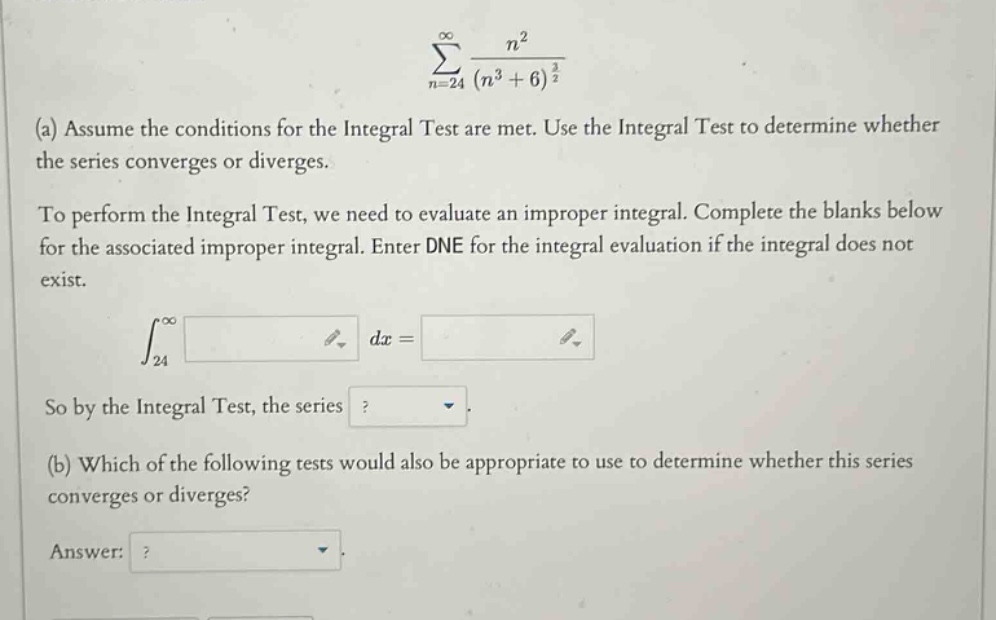
∑(n = 24 to ∞) n² / (n³ + 6)^(3/2) (a) assume the conditions for the integral test are met. use the integral test to determine whether the series converges or diverges. to perform the integral test, we need to evaluate an improper integral. complete the blanks below for the associated improper integral. enter dne for the integral evaluation if the integral does not exist. ∫(24 to ∞) dx = so by the integral test, the series ? (b) which of the following tests would also be appropriate to use to determine whether this series converges or diverges? answer: ?
Answer
Explanation:
Step1: Identify the function for integral test
Let (f(x)=\frac{x^{2}}{(x^{3}+6)^{\frac{3}{2}}}), then the associated improper - integral for the series (\sum_{n = 24}^{\infty}\frac{n^{2}}{(n^{3}+6)^{\frac{3}{2}}}) is (\int_{24}^{\infty}\frac{x^{2}}{(x^{3}+6)^{\frac{3}{2}}}dx).
Step2: Use substitution
Let (u=x^{3}+6), then (du = 3x^{2}dx) and (x^{2}dx=\frac{1}{3}du). When (x = 24), (u=24^{3}+6), and as (x\rightarrow\infty), (u\rightarrow\infty). So the integral becomes (\frac{1}{3}\int_{24^{3}+6}^{\infty}u^{-\frac{3}{2}}du).
Step3: Evaluate the integral
Using the power - rule for integration (\int u^{r}du=\frac{u^{r + 1}}{r+1}+C) ((r\neq - 1)), for (r=-\frac{3}{2}), we have (\frac{1}{3}\int_{24^{3}+6}^{\infty}u^{-\frac{3}{2}}du=\frac{1}{3}\lim_{b\rightarrow\infty}\int_{24^{3}+6}^{b}u^{-\frac{3}{2}}du=\frac{1}{3}\lim_{b\rightarrow\infty}\left[- 2u^{-\frac{1}{2}}\right]{24^{3}+6}^{b}). [ \begin{align*} &=\frac{1}{3}\lim{b\rightarrow\infty}\left(-\frac{2}{\sqrt{b}}+\frac{2}{\sqrt{24^{3}+6}}\right)\ &=\frac{2}{3\sqrt{24^{3}+6}} \end{align*} ] Since the improper integral (\int_{24}^{\infty}\frac{x^{2}}{(x^{3}+6)^{\frac{3}{2}}}dx) converges, by the Integral Test, the series (\sum_{n = 24}^{\infty}\frac{n^{2}}{(n^{3}+6)^{\frac{3}{2}}}) converges.
Step4: Determine other appropriate tests
The Limit Comparison Test can also be used. We can compare the series (\sum_{n = 24}^{\infty}\frac{n^{2}}{(n^{3}+6)^{\frac{3}{2}}}) with the series (\sum_{n = 24}^{\infty}\frac{n^{2}}{(n^{3})^{\frac{3}{2}}}=\sum_{n = 24}^{\infty}\frac{n^{2}}{n^{\frac{9}{2}}}=\sum_{n = 24}^{\infty}n^{2-\frac{9}{2}}=\sum_{n = 24}^{\infty}n^{-\frac{5}{2}}), which is a (p) - series with (p=\frac{5}{2}>1).
Answer:
(a) (\int_{24}^{\infty}\frac{x^{2}}{(x^{3}+6)^{\frac{3}{2}}}dx=\frac{2}{3\sqrt{24^{3}+6}}), converges (b) Limit Comparison Test