29. product rule\na) find the derivative and simplify.\nf(x)=(2x + 3)(3x - 2)\nb) find the derivative at…
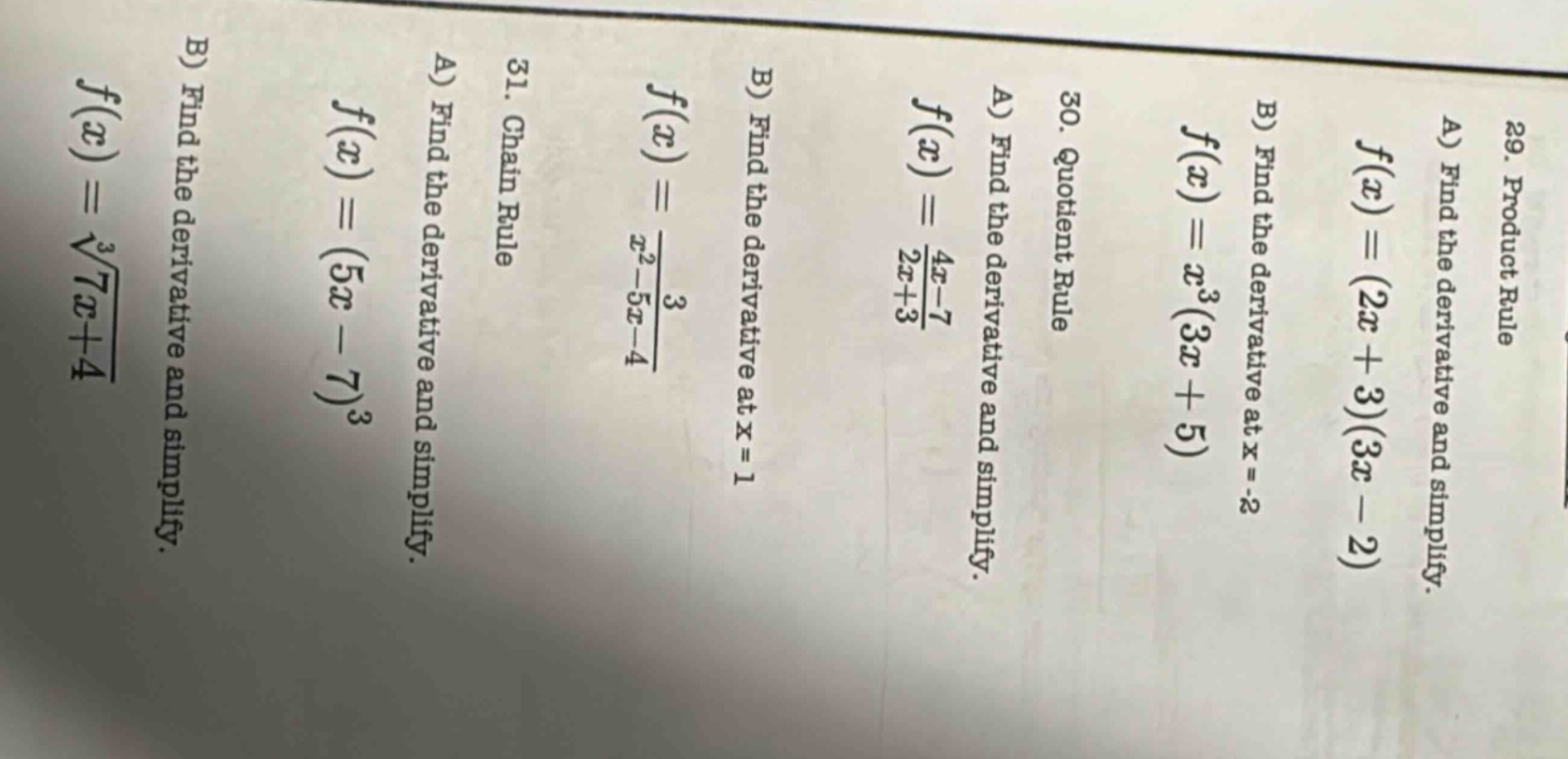
29. product rule\na) find the derivative and simplify.\nf(x)=(2x + 3)(3x - 2)\nb) find the derivative at x=-2\n30. quotient rule\na) find the derivative and simplify.\nf(x)=(4x - 7)/(2x+3)\nb) find the derivative at x = 1\n31. chain rule\na) find the derivative and simplify.\nf(x)=(5x - 7)^3\nb) find the derivative and simplify.\nf(x)=∛(7x+4)
Answer
29. Product Rule
Explanation:
Step1: Recall product - rule
The product - rule states that if (y = u\cdot v), where (u) and (v) are functions of (x), then (y^\prime=u^\prime v + uv^\prime). Let (u = 2x + 3) and (v=3x - 2).
Step2: Find (u^\prime) and (v^\prime)
Differentiate (u = 2x+3) with respect to (x), (u^\prime=\frac{d}{dx}(2x + 3)=2). Differentiate (v = 3x - 2) with respect to (x), (v^\prime=\frac{d}{dx}(3x - 2)=3).
Step3: Apply product - rule
(f^\prime(x)=u^\prime v+uv^\prime=2(3x - 2)+(2x + 3)\times3).
Step4: Expand and simplify
[ \begin{align*} f^\prime(x)&=6x-4 + 6x+9\ &=12x + 5 \end{align*} ]
Answer:
(f^\prime(x)=12x + 5)
30. Quotient Rule
Explanation:
Step1: Recall quotient - rule
The quotient - rule states that if (y=\frac{u}{v}), then (y^\prime=\frac{u^\prime v - uv^\prime}{v^{2}}), where (u = 4x-7) and (v = 2x + 3).
Step2: Find (u^\prime) and (v^\prime)
Differentiate (u = 4x-7) with respect to (x), (u^\prime = 4). Differentiate (v=2x + 3) with respect to (x), (v^\prime=2).
Step3: Apply quotient - rule
[ \begin{align*} f^\prime(x)&=\frac{4(2x + 3)-(4x - 7)\times2}{(2x + 3)^{2}}\ &=\frac{8x+12-(8x - 14)}{(2x + 3)^{2}}\ &=\frac{8x + 12-8x + 14}{(2x + 3)^{2}}\ &=\frac{26}{(2x + 3)^{2}} \end{align*} ]
Answer:
(f^\prime(x)=\frac{26}{(2x + 3)^{2}})
31. Chain Rule
A)
Explanation:
Step1: Let (u = 5x-7)
So (y = u^{3}), and by the chain - rule (\frac{dy}{dx}=\frac{dy}{du}\cdot\frac{du}{dx}).
Step2: Find (\frac{dy}{du}) and (\frac{du}{dx})
Differentiate (y = u^{3}) with respect to (u), (\frac{dy}{du}=3u^{2}). Differentiate (u = 5x-7) with respect to (x), (\frac{du}{dx}=5).
Step3: Apply chain - rule
(f^\prime(x)=\frac{dy}{du}\cdot\frac{du}{dx}=3(5x - 7)^{2}\times5 = 15(5x - 7)^{2})
Answer:
(f^\prime(x)=15(5x - 7)^{2})
B)
Explanation:
Step1: Let (y=\sqrt[3]{7x + 4}=(7x + 4)^{\frac{1}{3}}), and let (u = 7x+4)
So (y = u^{\frac{1}{3}}), and by the chain - rule (\frac{dy}{dx}=\frac{dy}{du}\cdot\frac{du}{dx}).
Step2: Find (\frac{dy}{du}) and (\frac{du}{dx})
Differentiate (y = u^{\frac{1}{3}}) with respect to (u), (\frac{dy}{du}=\frac{1}{3}u^{-\frac{2}{3}}). Differentiate (u = 7x + 4) with respect to (x), (\frac{du}{dx}=7).
Step3: Apply chain - rule
[ \begin{align*} f^\prime(x)&=\frac{1}{3}(7x + 4)^{-\frac{2}{3}}\times7\ &=\frac{7}{3(7x + 4)^{\frac{2}{3}}} \end{align*} ]
Answer:
(f^\prime(x)=\frac{7}{3(7x + 4)^{\frac{2}{3}}})