if f(x)=2x² - 4x + 5 and h is the inverse of f, what is the value of h(3)?\no a. 1/50\no b. 1/2\no c. 2\no…
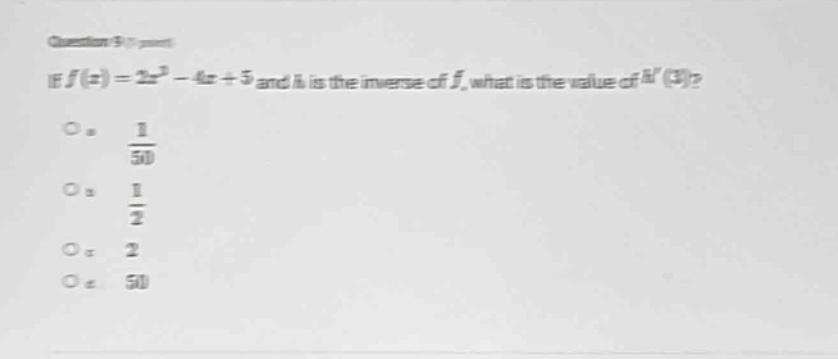
if f(x)=2x² - 4x + 5 and h is the inverse of f, what is the value of h(3)?\no a. 1/50\no b. 1/2\no c. 2\no d. 50
Answer
Explanation:
Step1: Recall the formula for the derivative of an inverse function
If $h$ is the inverse of $f$, then $h^{\prime}(y)=\frac{1}{f^{\prime}(x)}$ where $y = f(x)$. We need to find $x$ such that $f(x)=3$.
Step2: Set $f(x)$ equal to 3
Set $2x^{3}-4x + 5=3$, which simplifies to $2x^{3}-4x+2 = 0$. Divide through by 2 to get $x^{3}-2x + 1=0$. By inspection or factoring, we know that $x^{3}-2x + 1=(x - 1)(x^{2}+x - 1)$. The root of the equation $x^{3}-2x + 1 = 0$ is $x = 1$ (since $(1)^{3}-2(1)+1=1 - 2 + 1=0$).
Step3: Find the derivative of $f(x)$
Differentiate $f(x)=2x^{3}-4x + 5$ using the power - rule. $f^{\prime}(x)=\frac{d}{dx}(2x^{3}-4x + 5)=6x^{2}-4$.
Step4: Evaluate $f^{\prime}(x)$ at the found $x$ - value
Substitute $x = 1$ into $f^{\prime}(x)$. $f^{\prime}(1)=6(1)^{2}-4=6 - 4=2$.
Step5: Use the inverse - function derivative formula
Since $h^{\prime}(3)=\frac{1}{f^{\prime}(x)}$ and $x = 1$ when $f(x)=3$, then $h^{\prime}(3)=\frac{1}{f^{\prime}(1)}$. Substituting $f^{\prime}(1)=2$ into the formula, we get $h^{\prime}(3)=\frac{1}{2}$.
Answer:
$\frac{1}{2}$