f(x)=(-2x² + 8)/(x - 2)\nanswer attempt 1 out of 2\nhorizontal asymptote: y = \nno horizontal…
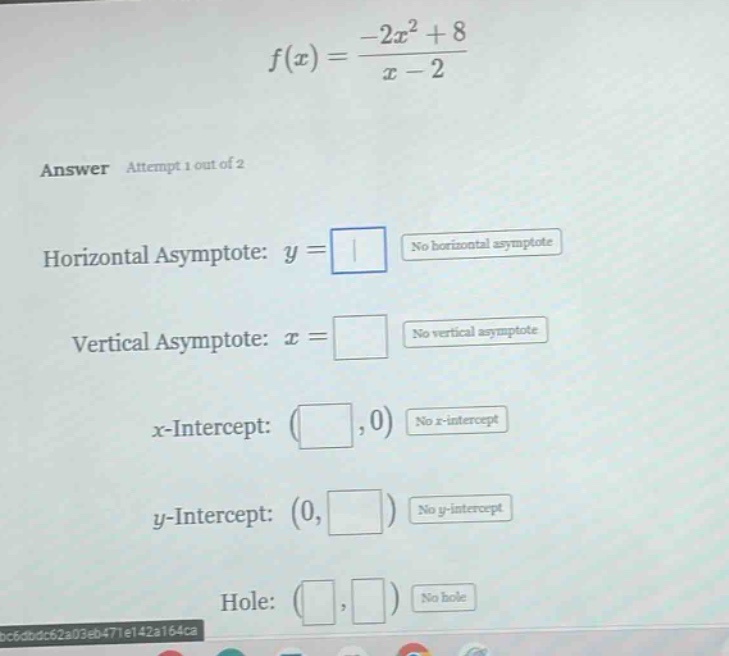
f(x)=(-2x² + 8)/(x - 2)\nanswer attempt 1 out of 2\nhorizontal asymptote: y = \nno horizontal asymptote\nvertical asymptote: x = \nno vertical asymptote\nx - intercept: ( ,0) no x - intercept\ny - intercept: (0, ) no y - intercept\nhole: ( , ) no hole
Answer
Explanation:
Step1: Simplify the function
First, factor the numerator: $-2x^{2}+8=-2(x^{2} - 4)=-2(x + 2)(x - 2)$. Then $f(x)=\frac{-2(x + 2)(x - 2)}{x - 2}=-2(x + 2)$ for $x\neq2$.
Step2: Find horizontal asymptote
Since the simplified function $y=-2x - 4$ is a linear - function, there is no horizontal asymptote.
Step3: Find vertical asymptote
The original function $f(x)=\frac{-2x^{2}+8}{x - 2}$ is undefined when $x - 2=0$, so $x = 2$ is a removable discontinuity (a hole), not a vertical asymptote. So, no vertical asymptote.
Step4: Find x - intercept
Set $y = 0$ in the simplified function $y=-2(x + 2)$. Then $0=-2(x + 2)$, which gives $x=-2$. So the x - intercept is $(-2,0)$.
Step5: Find y - intercept
Set $x = 0$ in the original function $f(0)=\frac{-2\times0^{2}+8}{0 - 2}=\frac{8}{-2}=-4$. So the y - intercept is $(0,-4)$.
Step6: Find the hole
The function is undefined at $x = 2$. Substitute $x = 2$ into the simplified function $y=-2(x + 2)$. When $x = 2$, $y=-2(2 + 2)=-8$. So the hole is at $(2,-8)$.
Answer:
Horizontal Asymptote: No horizontal asymptote Vertical Asymptote: No vertical asymptote x - Intercept: $(-2,0)$ y - Intercept: $(0,-4)$ Hole: $(2,-8)$