f(x)=2x + 1\nselect all the effects on the graph of the function when f(x) is multiplied by 3.\nthe x…
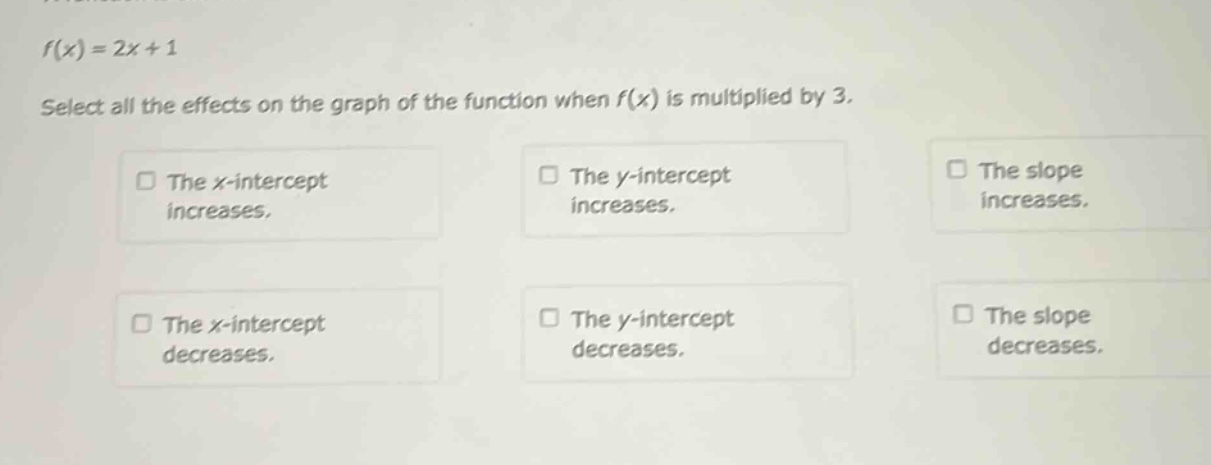
f(x)=2x + 1\nselect all the effects on the graph of the function when f(x) is multiplied by 3.\nthe x - intercept\nincreases.\nthe y - intercept\nincreases.\nthe slope\nincreases.\nthe x - intercept\ndecreases.\nthe y - intercept\ndecreases.\nthe slope\ndecreases.
Answer
Explanation:
Step1: Find the original (x)-intercept and (y)-intercept and slope
For the function (y = f(x)=2x + 1), the slope (m = 2), the (y)-intercept (b = 1). To find the (x)-intercept, set (y = 0): (0=2x + 1), then (x=-\frac{1}{2}).
Step2: Find the new function after multiplying by 3
The new function is (y = 3f(x)=3(2x + 1)=6x+3). The new slope (m'=6), the new (y)-intercept (b' = 3). To find the new (x)-intercept, set (y = 0): (0 = 6x+3), then (x=-\frac{1}{2}).
Step3: Analyze the changes
- Slope: Since (6>2), the slope increases.
- (y)-intercept: Since (3 > 1), the (y)-intercept increases.
- (x)-intercept: The original (x)-intercept is (x=-\frac{1}{2}), and the new (x)-intercept is also (x =-\frac{1}{2}) (no change).
Answer:
The (y)-intercept increases, The slope increases.