31. on which intervals is the following function increasing?\n$y = \\ln(x^{2}-2x)$\nselect…
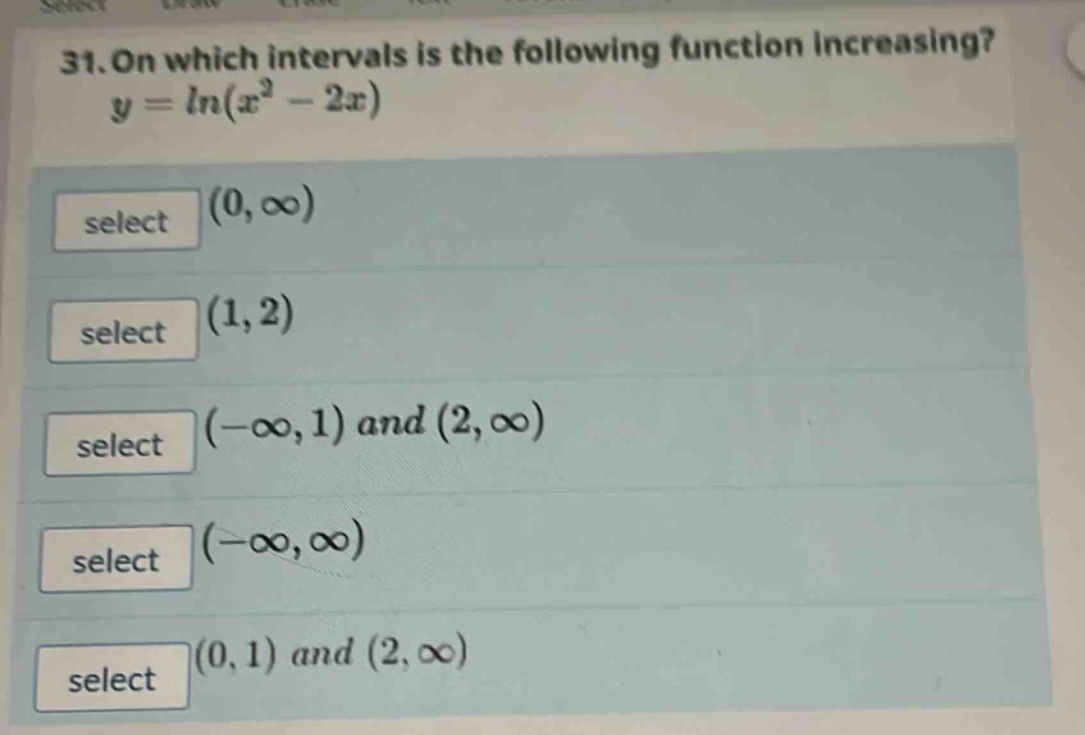
31. on which intervals is the following function increasing?\n$y = \\ln(x^{2}-2x)$\nselect $(0,\\infty)$\nselect $(1,2)$\nselect $(-\\infty,1)$ and $(2,\\infty)$\nselect $(-\\infty,\\infty)$\nselect $(0,1)$ and $(2,\\infty)$
Answer
Explanation:
Step1: Find the domain
For $y = \ln(x^{2}-2x)$, the argument $x^{2}-2x>0$. Factoring gives $x(x - 2)>0$. The solutions of the inequality are $x<0$ or $x>2$. So the domain is $(-\infty,0)\cup(2,\infty)$.
Step2: Differentiate the function
Using the chain - rule, if $y=\ln(u)$ and $u = x^{2}-2x$, then $y^\prime=\frac{u^\prime}{u}$. The derivative of $u=x^{2}-2x$ is $u^\prime = 2x - 2$. So $y^\prime=\frac{2x - 2}{x^{2}-2x}=\frac{2(x - 1)}{x(x - 2)}$.
Step3: Find where the derivative is positive
Set $y^\prime>0$. We consider the sign of $\frac{2(x - 1)}{x(x - 2)}$ in the intervals of the domain $(-\infty,0)$ and $(2,\infty)$. For the interval $(-\infty,0)$, if we take a test point $x=-1$, then $y^\prime=\frac{2(-1 - 1)}{(-1)(-1 - 2)}=\frac{-4}{3}<0$. For the interval $(2,\infty)$, if we take a test point $x = 3$, then $y^\prime=\frac{2(3 - 1)}{3(3 - 2)}=\frac{4}{3}>0$.
Answer:
$(2,\infty)$ (Note: None of the given options are completely correct as the correct interval is $(2,\infty)$ based on our calculations. If we assume there is a mis - typing and we consider the closest option, we can say the intended answer might be similar to the correct result among the options provided, but strictly speaking, none match exactly)