32.) l(t) models the length of each day (in minutes) in manila, phillippines t days after the spring…
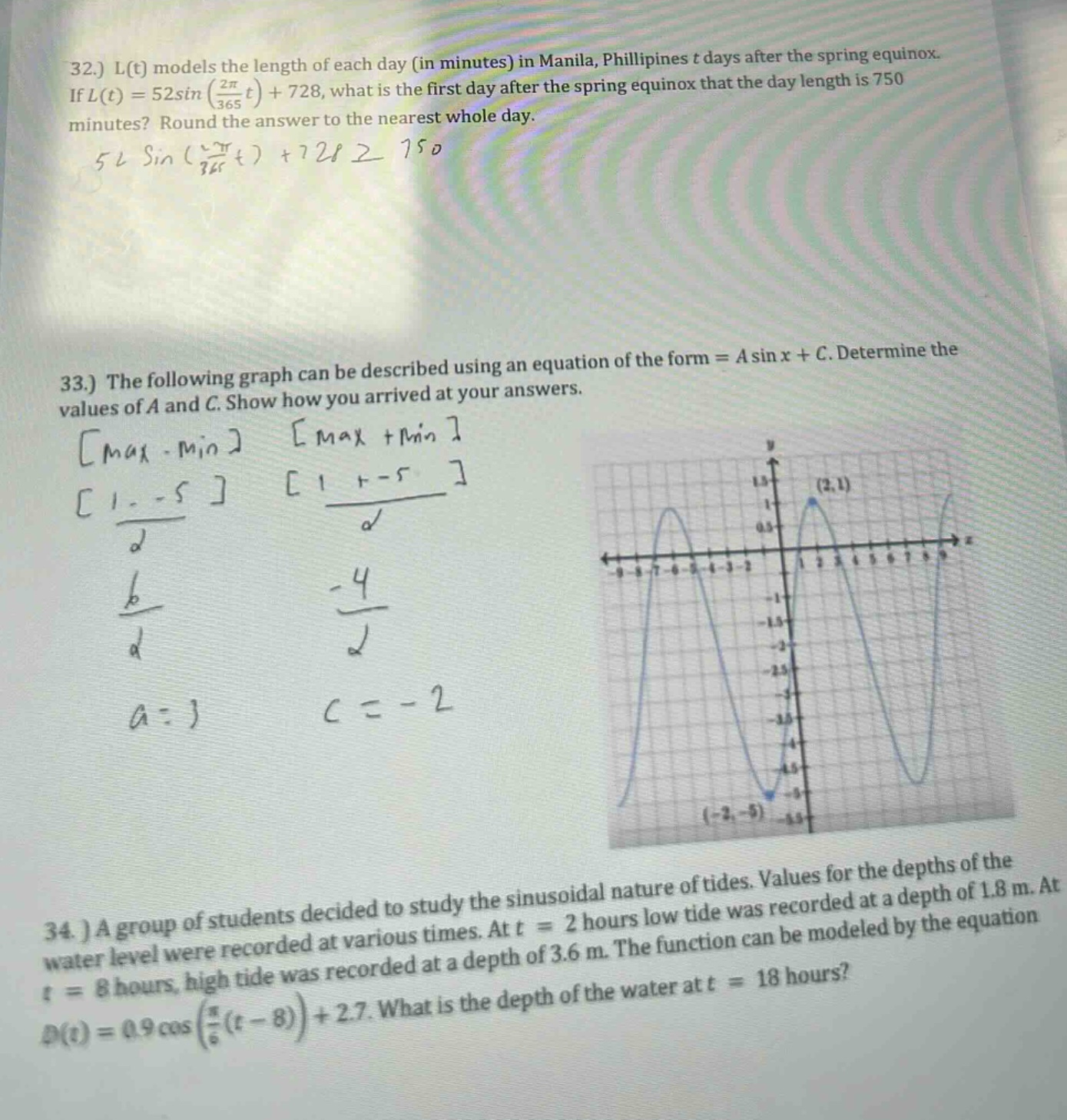
32.) l(t) models the length of each day (in minutes) in manila, phillippines t days after the spring equinox. if l(t)=52sin((2π/365)t)+728, what is the first day after the spring equinox that the day length is 750 minutes? round the answer to the nearest whole day.\n52 sin((2π/365)t)+728 = 750\n33.) the following graph can be described using an equation of the form = asin x + c. determine the values of a and c. show how you arrived at your answers.\nmax - min\nmax + min\n1 - - 5\n1 + - 5\n/2\n/2\na = \nc = - 2\n34.) a group of students decided to study the sinusoidal nature of tides. values for the depths of the water level were recorded at various times. at t = 2 hours low tide was recorded at a depth of 1.8 m. at t = 8 hours, high tide was recorded at a depth of 3.6 m. the function can be modeled by the equation d(t)=0.9cos((π/6)(t - 8))+2.7. what is the depth of the water at t = 18 hours?
Answer
Explanation:
Step1: Set up the equation for problem 32
Set $L(t)=750$, so $52\sin(\frac{2\pi}{365}t)+728 = 750$.
Step2: Isolate the sine - term
Subtract 728 from both sides: $52\sin(\frac{2\pi}{365}t)=750 - 728=22$. Then $\sin(\frac{2\pi}{365}t)=\frac{22}{52}=\frac{11}{26}$.
Step3: Solve for $\frac{2\pi}{365}t$
Using the inverse - sine function, $\frac{2\pi}{365}t=\sin^{- 1}(\frac{11}{26})+2k\pi$ or $\frac{2\pi}{365}t=\pi-\sin^{- 1}(\frac{11}{26})+2k\pi$, $k\in\mathbb{Z}$. We want the first positive $t$, so we start with $k = 0$. First, $\sin^{- 1}(\frac{11}{26})\approx0.437$ radians. Then $\frac{2\pi}{365}t\approx0.437$ (we take the principal value of the inverse - sine for the first solution).
Step4: Solve for $t$
$t=\frac{0.437\times365}{2\pi}\approx\frac{159.505}{2\pi}\approx25$ days.
Step5: For problem 33
The amplitude $A$ of a sine function $y = A\sin x+C$ is given by $A=\frac{\text{Max}-\text{Min}}{2}$. From the graph, $\text{Max}=1$ and $\text{Min}=-5$. So $A=\frac{1-(-5)}{2}=\frac{6}{2}=3$. The vertical shift $C$ is given by $C=\frac{\text{Max}+\text{Min}}{2}=\frac{1+( - 5)}{2}=\frac{-4}{2}=-2$.
Step6: For problem 34
Substitute $t = 18$ into the function $D(t)=0.9\cos(\frac{\pi}{6}(t - 8))+2.7$. First, calculate $\frac{\pi}{6}(t - 8)$ when $t = 18$: $\frac{\pi}{6}(18 - 8)=\frac{10\pi}{6}=\frac{5\pi}{3}$. Then $\cos(\frac{5\pi}{3})=\frac{1}{2}$. So $D(18)=0.9\times\frac{1}{2}+2.7=0.45 + 2.7=3.15$ m.
Answer:
- 25 days
- $A = 3$, $C=-2$
- $3.15$ m