34 throughout which of the following intervals is $f(x)=(x - 1)(x - 4)^2$ only decreasing?\n(a)…
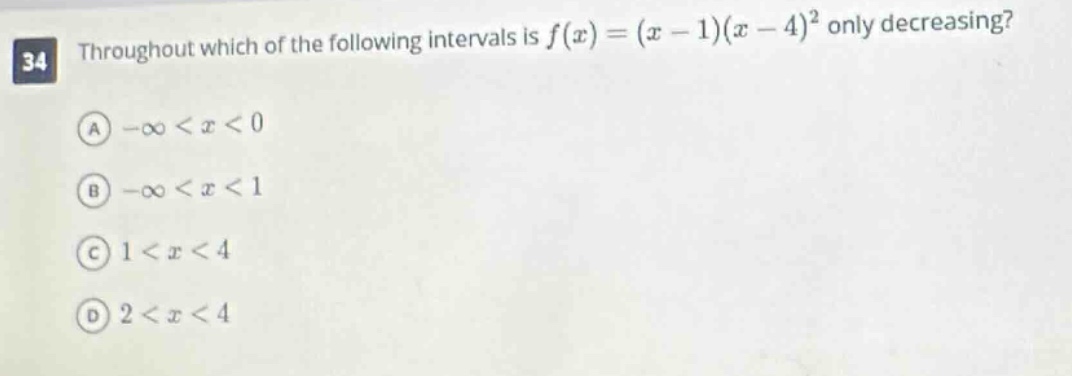
34 throughout which of the following intervals is $f(x)=(x - 1)(x - 4)^2$ only decreasing?\n(a) $-infty<x<0$\n(b) $-infty<x<1$\n(c) $1<x<4$\n(d) $2<x<4$
Answer
Explanation:
Step1: Expand the function
[ \begin{align*} f(x)&=(x - 1)(x - 4)^{2}\ &=(x - 1)(x^{2}-8x + 16)\ &=x^{3}-8x^{2}+16x-x^{2}+8x - 16\ &=x^{3}-9x^{2}+24x - 16 \end{align*} ]
Step2: Find the derivative
Using the power - rule ((x^n)^\prime=nx^{n - 1}), we have (f^\prime(x)=3x^{2}-18x + 24).
Step3: Factor the derivative
[ \begin{align*} f^\prime(x)&=3x^{2}-18x + 24\ &=3(x^{2}-6x + 8)\ &=3(x - 2)(x - 4) \end{align*} ]
Step4: Determine where the function is decreasing
A function (y = f(x)) is decreasing when (f^\prime(x)<0). Set (f^\prime(x)=3(x - 2)(x - 4)<0). The roots of (f^\prime(x)) are (x = 2) and (x = 4). Using a sign - chart or testing intervals, we find that (f^\prime(x)<0) when (2<x<4).
Answer:
D. (2 < x < 4)