36 which function shown below has a greater average rate of change on the interval -2,4? justify your…
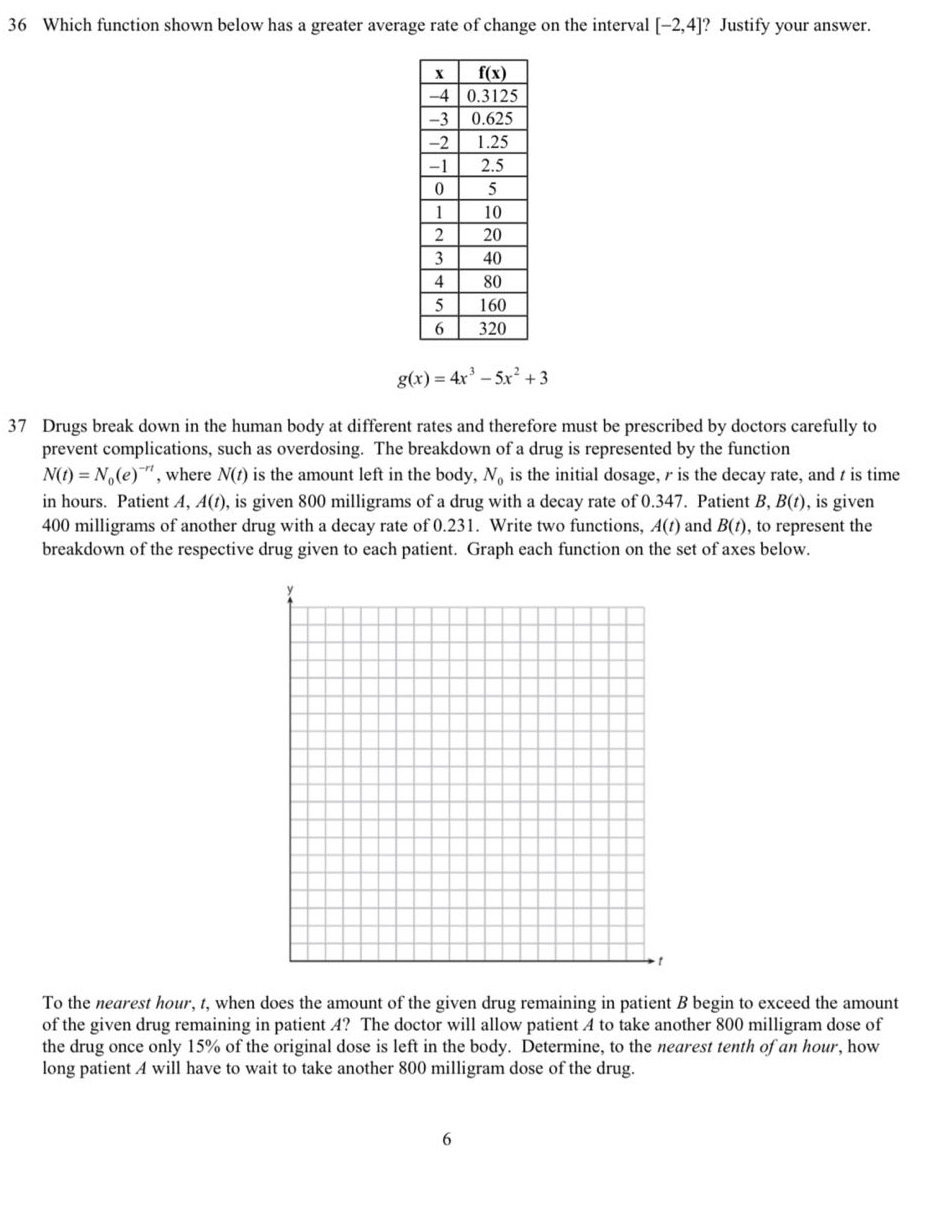
36 which function shown below has a greater average rate of change on the interval -2,4? justify your answer. x f(x) -4 0.3125 -3 0.625 -2 1.25 -1 2.5 0 5 1 10 2 20 3 40 4 80 5 160 6 320 g(x)=4x³ - 5x²+3 37 drugs break down in the human body at different rates and therefore must be prescribed by doctors carefully to prevent complications, such as overdosing. the breakdown of a drug is represented by the function n(t)=n₀(e)⁻ʳᵗ, where n(t) is the amount left in the body, n₀ is the initial dosage, r is the decay rate, and t is time in hours. patient a, a(t), is given 800 milligrams of a drug with a decay rate of 0.347. patient b, b(t), is given 400 milligrams of another drug with a decay rate of 0.231. write two functions, a(t) and b(t), to represent the breakdown of the respective drug given to each patient. graph each function on the set of axes below. to the nearest hour, t, when does the amount of the given drug remaining in patient b begin to exceed the amount of the given drug remaining in patient a? the doctor will allow patient a to take another 800 - milligram dose of the drug once only 15% of the original dose is left in the body. determine, to the nearest tenth of an hour, how long patient a will have to wait to take another 800 - milligram dose of the drug.
Answer
36
Explanation:
Step1: Recall average - rate - of - change formula
The average rate of change of a function $y = f(x)$ on the interval $[a,b]$ is $\frac{f(b)-f(a)}{b - a}$.
Step2: Calculate average rate of change for $f(x)$
For $f(x)$ on the interval $[-2,4]$, $a=-2$, $b = 4$, $f(-2)=1.25$, $f(4)=80$. The average rate of change of $f(x)$ is $\frac{f(4)-f(-2)}{4-(-2)}=\frac{80 - 1.25}{6}=\frac{78.75}{6}=13.125$.
Step3: Calculate average rate of change for $g(x)$
First, find $g(-2)$ and $g(4)$. $g(x)=4x^{3}-5x^{2}+3$. $g(-2)=4(-2)^{3}-5(-2)^{2}+3=4\times(-8)-5\times4 + 3=-32-20 + 3=-49$. $g(4)=4\times4^{3}-5\times4^{2}+3=4\times64-5\times16 + 3=256-80 + 3=179$. The average rate of change of $g(x)$ is $\frac{g(4)-g(-2)}{4-(-2)}=\frac{179-(-49)}{6}=\frac{179 + 49}{6}=\frac{228}{6}=38$.
Answer:
The function $g(x)$ has a greater average rate of change on the interval $[-2,4]$ since the average rate of change of $f(x)$ is $13.125$ and the average rate of change of $g(x)$ is $38$.
37
Explanation:
Step1: Write the functions for $A(t)$ and $B(t)$
For patient $A$, $N_0 = 800$ and $r = 0.347$, so $A(t)=800e^{-0.347t}$. For patient $B$, $N_0 = 400$ and $r = 0.231$, so $B(t)=400e^{-0.231t}$.
Step2: Find when $B(t)>A(t)$
Set $400e^{-0.231t}>800e^{-0.347t}$. Divide both sides by $400$: $e^{-0.231t}>2e^{-0.347t}$. Divide both sides by $e^{-0.347t}$: $e^{-0.231t+0.347t}>2$, i.e., $e^{0.116t}>2$. Take the natural - logarithm of both sides: $0.116t>\ln(2)$. $t>\frac{\ln(2)}{0.116}\approx\frac{0.693}{0.116}\approx6$ hours.
Step3: Find when patient $A$ can take another dose
We want to find $t$ when $A(t)=0.15\times800 = 120$. Set $800e^{-0.347t}=120$. $e^{-0.347t}=\frac{120}{800}=0.15$. Take the natural - logarithm of both sides: $-0.347t=\ln(0.15)$. $t=\frac{\ln(0.15)}{-0.347}\approx\frac{-1.897}{-0.347}\approx5.5$ hours.
Answer:
- $A(t)=800e^{-0.347t}$
- $B(t)=400e^{-0.231t}$
- Patient $B$'s drug amount exceeds patient $A$'s at approximately $6$ hours.
- Patient $A$ has to wait approximately $5.5$ hours to take another dose.