f(x) = (3x - 7)/(4x + 14) answer attempt 1 out of 2 horizontal asymptote: y = no horizontal asymptote…
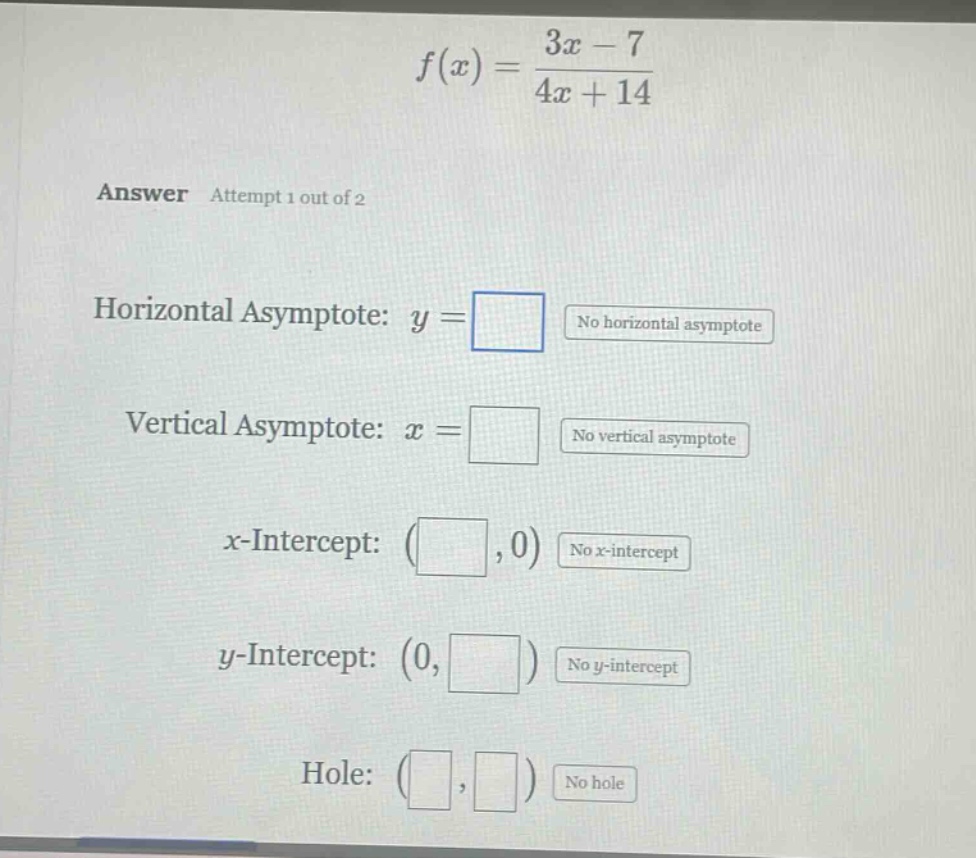
f(x) = (3x - 7)/(4x + 14) answer attempt 1 out of 2 horizontal asymptote: y = no horizontal asymptote vertical asymptote: x = no vertical asymptote x - intercept: ( , 0) no x - intercept y - intercept: (0, ) no y - intercept hole: ( , ) no hole
Answer
Explanation:
Step1: Find horizontal asymptote
For rational function $f(x)=\frac{3x - 7}{4x+14}$, since degree of numerator and denominator are same (both 1), horizontal asymptote is $y=\frac{\text{leading - coefficient of numerator}}{\text{leading - coefficient of denominator}}$. So $y = \frac{3}{4}$.
Step2: Find vertical asymptote
Set denominator equal to 0. $4x + 14=0$, then $4x=-14$, and $x =-\frac{14}{4}=-\frac{7}{2}$.
Step3: Find x - intercept
Set $y = 0$, so $\frac{3x - 7}{4x + 14}=0$. Then $3x-7 = 0$, and $x=\frac{7}{3}$.
Step4: Find y - intercept
Set $x = 0$, then $y=\frac{3\times0 - 7}{4\times0+14}=-\frac{7}{14}=-\frac{1}{2}$.
Step5: Check for hole
Factor numerator and denominator. $f(x)=\frac{3x - 7}{4x + 14}=\frac{3x - 7}{2(2x + 7)}$. There are no common factors in numerator and denominator, so no hole.
Answer:
Horizontal Asymptote: $y=\frac{3}{4}$ Vertical Asymptote: $x =-\frac{7}{2}$ x - Intercept: $(\frac{7}{3},0)$ y - Intercept: $(0,-\frac{1}{2})$ Hole: No hole