f(x) = (x^2 - 9)/(3x^2 + 6x - 9). find the equations of the horizontal asymptotes and the vertical…
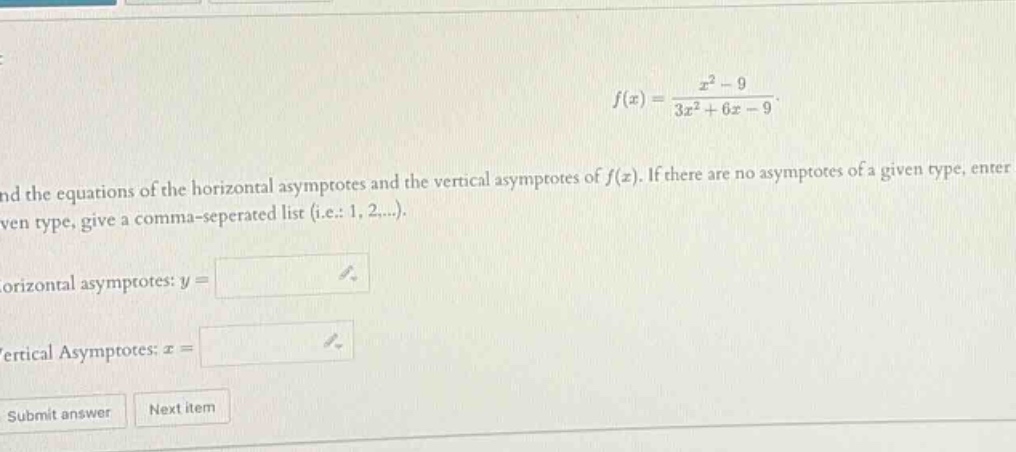
f(x) = (x^2 - 9)/(3x^2 + 6x - 9). find the equations of the horizontal asymptotes and the vertical asymptotes of f(x). if there are no asymptotes of a given type, enter given type, give a comma - separated list (i.e.: 1, 2,...). horizontal asymptotes: y = vertical asymptotes: x =
Answer
Explanation:
Step1: Simplify the function
First, factor the numerator and denominator. The numerator $x^{2}-9=(x + 3)(x - 3)$. The denominator $3x^{2}+6x - 9=3(x^{2}+2x - 3)=3(x + 3)(x - 1)$. So, $f(x)=\frac{(x + 3)(x - 3)}{3(x + 3)(x - 1)}=\frac{x - 3}{3(x - 1)},x\neq - 3$.
Step2: Find horizontal asymptotes
For a rational - function $y=\frac{f(x)}{g(x)}$ where $f(x)$ and $g(x)$ are polynomials, if the degree of $f(x)$ and $g(x)$ are the same (both are of degree 1 here), the horizontal asymptote is given by $y=\frac{a}{b}$, where $a$ is the leading coefficient of $f(x)$ and $b$ is the leading coefficient of $g(x)$. The leading coefficient of $x - 3$ is 1 and the leading coefficient of $3(x - 1)$ is 3. So, the horizontal asymptote is $y=\frac{1}{3}$.
Step3: Find vertical asymptotes
Vertical asymptotes occur at the values of $x$ that make the denominator equal to zero. Set the denominator $3(x - 1)=0$. Solving for $x$, we get $x = 1$.
Answer:
Horizontal asymptotes: $y=\frac{1}{3}$ Vertical Asymptotes: $x = 1$