9. -/1.42 points details my notes test the series for convergence or divergence. ∑n = 26 to ∞ ((-1)^(n…
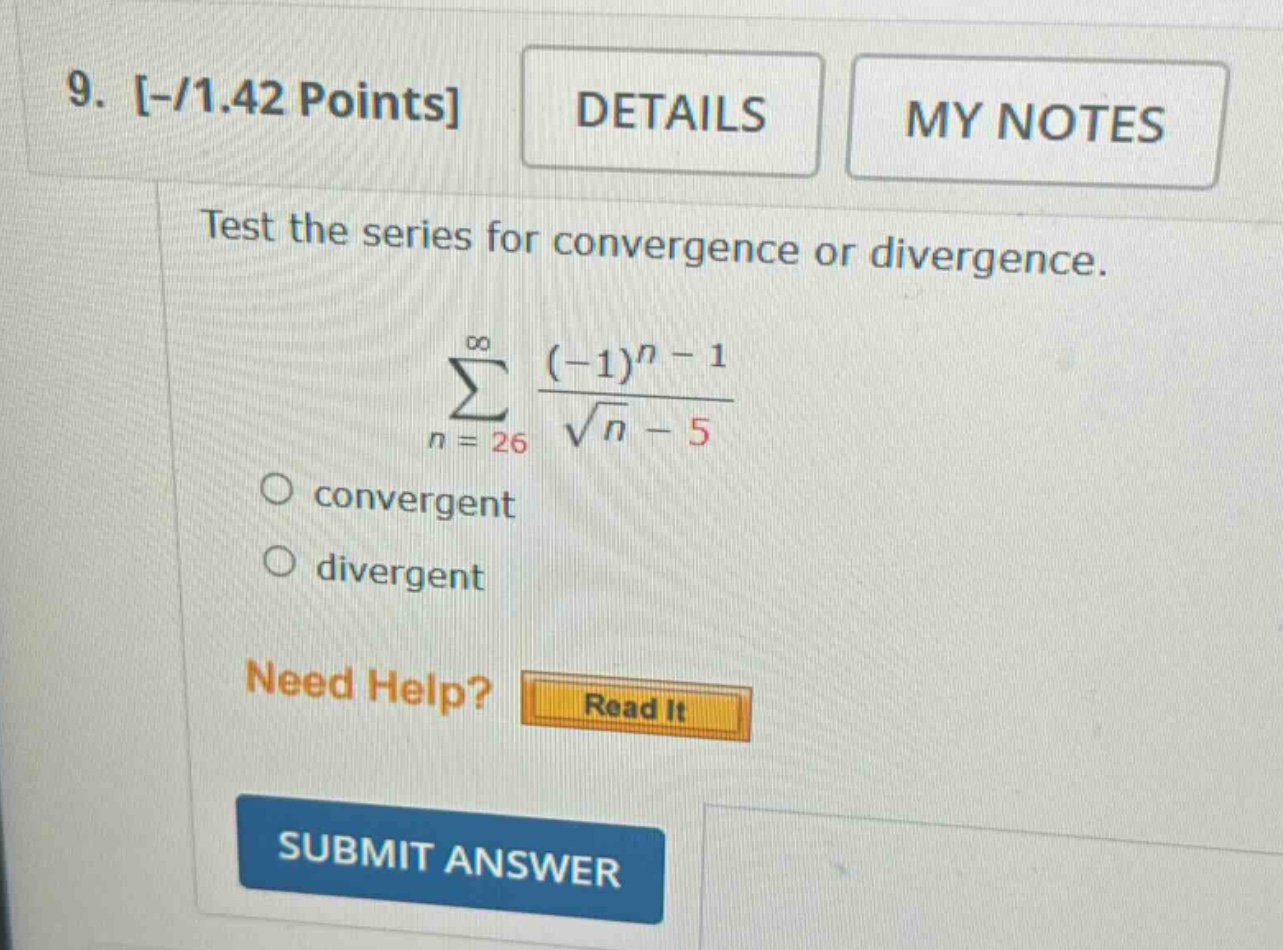
9. -/1.42 points details my notes test the series for convergence or divergence. ∑n = 26 to ∞ ((-1)^(n - 1))/(√n - 5) convergent divergent need help? read it submit answer
Answer
Explanation:
Step1: Recall alternating - series test
The given series $\sum_{n = 26}^{\infty}\frac{(- 1)^{n - 1}}{\sqrt{n}-5}$ is an alternating series of the form $\sum_{n = N}^{\infty}(-1)^{n - 1}a_n$, where $a_n=\frac{1}{\sqrt{n}-5}$ and $N = 26$.
Step2: Check the conditions of the alternating - series test
Condition 1: $\lim_{n\rightarrow\infty}a_n$
We find $\lim_{n\rightarrow\infty}a_n=\lim_{n\rightarrow\infty}\frac{1}{\sqrt{n}-5}$. As $n\rightarrow\infty$, $\sqrt{n}\rightarrow\infty$, so $\lim_{n\rightarrow\infty}\frac{1}{\sqrt{n}-5}=0$.
Condition 2: $a_{n+1}\leq a_n$ for $n\geq N$
Let $f(x)=\frac{1}{\sqrt{x}-5}$, then $f^\prime(x)=-\frac{1}{2\sqrt{x}(\sqrt{x}-5)^2}<0$ for $x\geq26$. So $a_{n + 1}=\frac{1}{\sqrt{n + 1}-5}\leq\frac{1}{\sqrt{n}-5}=a_n$ for $n\geq26$. Since both conditions of the alternating - series test are satisfied, the series $\sum_{n = 26}^{\infty}\frac{(-1)^{n - 1}}{\sqrt{n}-5}$ is convergent.
Answer:
convergent