43. -/2 points details my notes larpcalclimaga8 5.4.074, 0/6 submissions used use a graphing utility to…
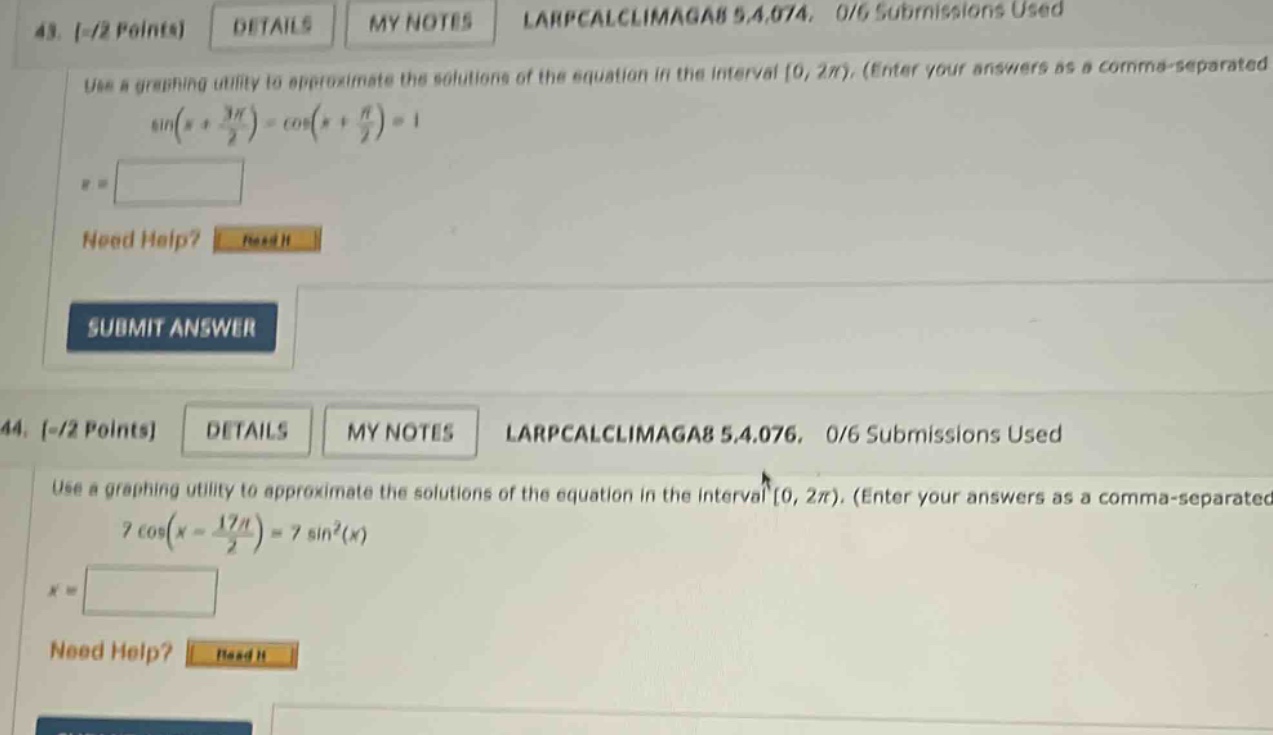
43. -/2 points details my notes larpcalclimaga8 5.4.074, 0/6 submissions used use a graphing utility to approximate the solutions of the equation in the interval 0, 2π). (enter your answers as a comma - separated sin(x + 3π/2)=cos(x + π/2)=1 x = need help? read it submit answer 44. -/2 points details my notes larpcalclimaga8 5.4.076, 0/6 submissions used use a graphing utility to approximate the solutions of the equation in the interval 0, 2π). (enter your answers as a comma - separated 7cos(x - 17π/2)=7sin²(x) x = need help? read it
Answer
Explanation:
Step1: Simplify the first - equation
Use the trigonometric identities. We know that $\sin(A + B)=\sin A\cos B+\cos A\sin B$ and $\cos(A + B)=\cos A\cos B-\sin A\sin B$. For $\sin(x+\frac{3\pi}{2})=-\cos x$ and $\cos(x + \frac{\pi}{2})=-\sin x$. The equation $\sin(x+\frac{3\pi}{2})-\cos(x+\frac{\pi}{2}) = 1$ becomes $-\cos x+\sin x = 1$, or $\sin x-\cos x = 1$. Square both sides: $(\sin x-\cos x)^2=1^2$. Expanding gives $\sin^{2}x - 2\sin x\cos x+\cos^{2}x = 1$. Since $\sin^{2}x+\cos^{2}x = 1$, the equation simplifies to $1 - 2\sin x\cos x=1$, so $\sin x\cos x = 0$. If $\sin x = 0$, then $x = 0,\pi,2\pi$ (but we are in the interval $[0,2\pi)$ so we consider $x = 0,\pi$). Substituting into $\sin x-\cos x = 1$, when $x = 0$, $\sin(0)-\cos(0)=- 1\neq1$, when $x=\pi$, $\sin(\pi)-\cos(\pi)=1$. If $\cos x = 0$, then $x=\frac{\pi}{2},\frac{3\pi}{2}$. When $x=\frac{\pi}{2}$, $\sin(\frac{\pi}{2})-\cos(\frac{\pi}{2})=1$.
Step2: Simplify the second - equation
The equation $7\cos(x-\frac{17\pi}{2})=7\sin^{2}x$. We know that $\cos(A - B)=\cos A\cos B+\sin A\sin B$. Also, $\cos(x-\frac{17\pi}{2})=\cos(x - 8\pi-\frac{\pi}{2})=\cos(x-\frac{\pi}{2})=\sin x$. The equation becomes $\sin x=\sin^{2}x$, or $\sin^{2}x-\sin x = 0$. Factor out $\sin x$: $\sin x(\sin x - 1)=0$. If $\sin x = 0$, then $x = 0,\pi$ in the interval $[0,2\pi)$. If $\sin x = 1$, then $x=\frac{\pi}{2}$.
Answer:
For the first equation: $\frac{\pi}{2},\pi$; For the second equation: $0,\frac{\pi}{2},\pi$