f(x)=|4x - 20|\nf(x)=f(x)\n∫_{-5}^{5}f(x)dx=
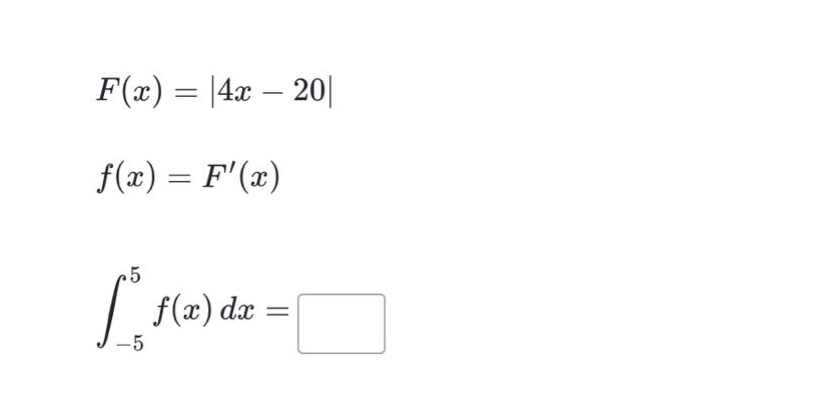
f(x)=|4x - 20|\nf(x)=f(x)\n∫_{-5}^{5}f(x)dx=
Answer
Explanation:
Step1: Rewrite absolute - value function
Rewrite $F(x)=|4x - 20|$ as $F(x)=\begin{cases}4x - 20, & x\geq5\-(4x - 20), & x<5\end{cases}$.
Step2: Find the derivative of $F(x)$
For $x>5$, $F^{\prime}(x)=\frac{d}{dx}(4x - 20)=4$; for $x<5$, $F^{\prime}(x)=\frac{d}{dx}[-(4x - 20)]=-4$. At $x = 5$, the derivative of $F(x)$ does not exist. But we can still calculate the integral using the fundamental theorem of calculus in a piece - wise sense.
Step3: Split the integral
$\int_{-5}^{5}f(x)dx=\int_{-5}^{5}F^{\prime}(x)dx=\int_{-5}^{5}\frac{dF(x)}{dx}dx$. By the fundamental theorem of calculus, $\int_{-5}^{5}F^{\prime}(x)dx=F(5)-F(-5)$.
Step4: Calculate $F(5)$ and $F(-5)$
$F(5)=|4\times5 - 20|=0$, $F(-5)=|4\times(-5)-20|=|-20 - 20| = 40$.
Step5: Calculate the value of the integral
$\int_{-5}^{5}f(x)dx=F(5)-F(-5)=0 - 40=-40$.
Answer:
$-40$