54. ∑(from k = 1 to ∞) ((1 / (k + 2)) - (1 / (k + 3)))
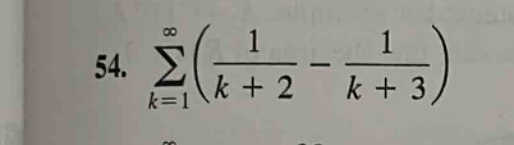
54. ∑(from k = 1 to ∞) ((1 / (k + 2)) - (1 / (k + 3)))
Answer
Explanation:
Step1: Expand the series
Let's write out the first - few terms of the series. When (k = 1), the term is (\frac{1}{1 + 2}-\frac{1}{1+3}=\frac{1}{3}-\frac{1}{4}); when (k = 2), the term is (\frac{1}{2 + 2}-\frac{1}{2+3}=\frac{1}{4}-\frac{1}{5}); when (k = 3), the term is (\frac{1}{3 + 2}-\frac{1}{3+3}=\frac{1}{5}-\frac{1}{6}); and in general, for the (n) - th partial sum (S_n=\sum_{k = 1}^{n}(\frac{1}{k + 2}-\frac{1}{k + 3})).
Step2: Observe the telescoping property
(S_n=(\frac{1}{3}-\frac{1}{4})+(\frac{1}{4}-\frac{1}{5})+(\frac{1}{5}-\frac{1}{6})+\cdots+(\frac{1}{n + 2}-\frac{1}{n+3})). We can see that most of the terms cancel out. The (-\frac{1}{4}) and (\frac{1}{4}), (-\frac{1}{5}) and (\frac{1}{5}), etc. cancel. So, (S_n=\frac{1}{3}-\frac{1}{n + 3}).
Step3: Find the sum of the infinite series
We want to find (\sum_{k = 1}^{\infty}(\frac{1}{k + 2}-\frac{1}{k + 3})=\lim_{n\rightarrow\infty}S_n). (\lim_{n\rightarrow\infty}S_n=\lim_{n\rightarrow\infty}(\frac{1}{3}-\frac{1}{n + 3})). As (n\rightarrow\infty), (\frac{1}{n + 3}\rightarrow0). So, (\lim_{n\rightarrow\infty}(\frac{1}{3}-\frac{1}{n + 3})=\frac{1}{3}).
Answer:
(\frac{1}{3})