o y = 5x grows slower than y = 5^x.\no y = 5x grows faster than y = 5^x.\no y = 5^x grows at the same rate…
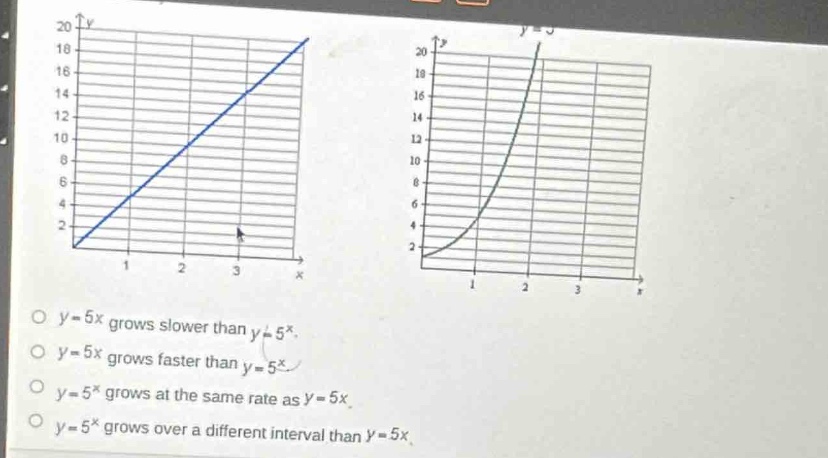
o y = 5x grows slower than y = 5^x.\no y = 5x grows faster than y = 5^x.\no y = 5^x grows at the same rate as y = 5x.\no y = 5^x grows over a different interval than y = 5x.
Answer
Explanation:
Step1: Analyze linear - exponential growth
The function $y = 5x$ is a linear function with a constant slope of 5. The function $y=5^{x}$ is an exponential function with a base of 5.
Step2: Compare growth rates
For small values of $x$, the linear function $y = 5x$ may be larger. But as $x$ increases, the exponential function $y = 5^{x}$ will grow much faster. For example, when $x = 1$, $y = 5x=5$ and $y = 5^{x}=5$; when $x = 2$, $y = 5x = 10$ and $y=5^{x}=25$; when $x = 3$, $y = 5x=15$ and $y = 5^{x}=125$. As $x$ gets larger, the difference between the values of $y = 5^{x}$ and $y = 5x$ becomes more and more significant.
Answer:
$y = 5x$ grows slower than $y = 5^{x}$.