68. ∑(√(k + 1) - √k) from k = 1 to ∞
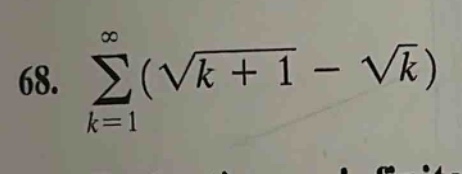
68. ∑(√(k + 1) - √k) from k = 1 to ∞
Answer
Explanation:
Step1: Expand the partial - sum
Let (S_N=\sum_{k = 1}^{N}(\sqrt{k + 1}-\sqrt{k})). Expand the sum: [ \begin{align*} S_N&=(\sqrt{2}-\sqrt{1})+(\sqrt{3}-\sqrt{2})+(\sqrt{4}-\sqrt{3})+\cdots+(\sqrt{N + 1}-\sqrt{N}) \end{align*} ]
Step2: Simplify the sum by cancellation
By cancellation, most of the terms will be eliminated. We have (S_N=\sqrt{N + 1}-1).
Step3: Find the limit as (N\to\infty)
We want to find (\lim_{N\to\infty}S_N=\lim_{N\to\infty}(\sqrt{N + 1}-1)). As (N\to\infty), (\sqrt{N+1}\to\infty), so (\lim_{N\to\infty}(\sqrt{N + 1}-1)=\infty).
Answer:
The series (\sum_{k = 1}^{\infty}(\sqrt{k + 1}-\sqrt{k})) diverges.