68. sketch the graph of f(x) = {x² + 4x + 2, x < -2; 1 - 4x - x², x ≥ -2. (a) is f continuous at x = -2? (b)…
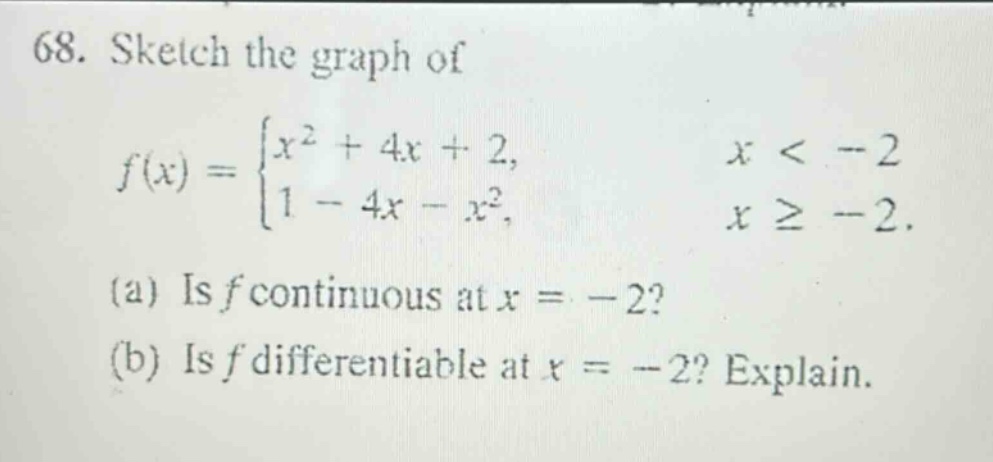
68. sketch the graph of f(x) = {x² + 4x + 2, x < -2; 1 - 4x - x², x ≥ -2. (a) is f continuous at x = -2? (b) is f differentiable at x = -2? explain.
Answer
Explanation:
Step1: Calculate left - hand limit
For (x < - 2), (f(x)=x^{2}+4x + 2). (\lim_{x\rightarrow - 2^{-}}f(x)=\lim_{x\rightarrow - 2^{-}}(x^{2}+4x + 2)=(-2)^{2}+4\times(-2)+2=4 - 8 + 2=-2)
Step2: Calculate right - hand limit
For (x\geq - 2), (f(x)=1 - 4x - x^{2}). (\lim_{x\rightarrow - 2^{+}}f(x)=\lim_{x\rightarrow - 2^{+}}(1 - 4x - x^{2})=1-4\times(-2)-(-2)^{2}=1 + 8 - 4 = 5)
Step3: Calculate function value at (x=-2)
(f(-2)=1-4\times(-2)-(-2)^{2}=1 + 8 - 4 = 5)
Step4: Check continuity
Since (\lim_{x\rightarrow - 2^{-}}f(x)=-2\neq\lim_{x\rightarrow - 2^{+}}f(x) = 5), the function is not continuous at (x = - 2).
Step5: Check differentiability
A function is not differentiable at a point where it is not continuous. Since (f(x)) is not continuous at (x=-2), it is not differentiable at (x = - 2).
Answer:
(a) No (b) No, because the function is not continuous at (x=-2) and a function must be continuous at a point to be differentiable at that point.