f(x)=6cos(x)\nf(x)=3cos(x)+3\nf(x)=6sin(x)\nf(x)=3sin(x)+3
f(x)=6cos(x)\nf(x)=3cos(x)+3\nf(x)=6sin(x)\nf(x)=3sin(x)+3
Answer
Explanation:
Step1: Recall general form of sine - cosine function
The general form of a sinusoidal function is $y = A\sin(Bx - C)+D$ or $y=A\cos(Bx - C)+D$, where $|A|$ is the amplitude, $\frac{2\pi}{|B|}$ is the period, $C$ is the phase - shift and $D$ is the vertical shift.
Step2: Analyze the vertical shift
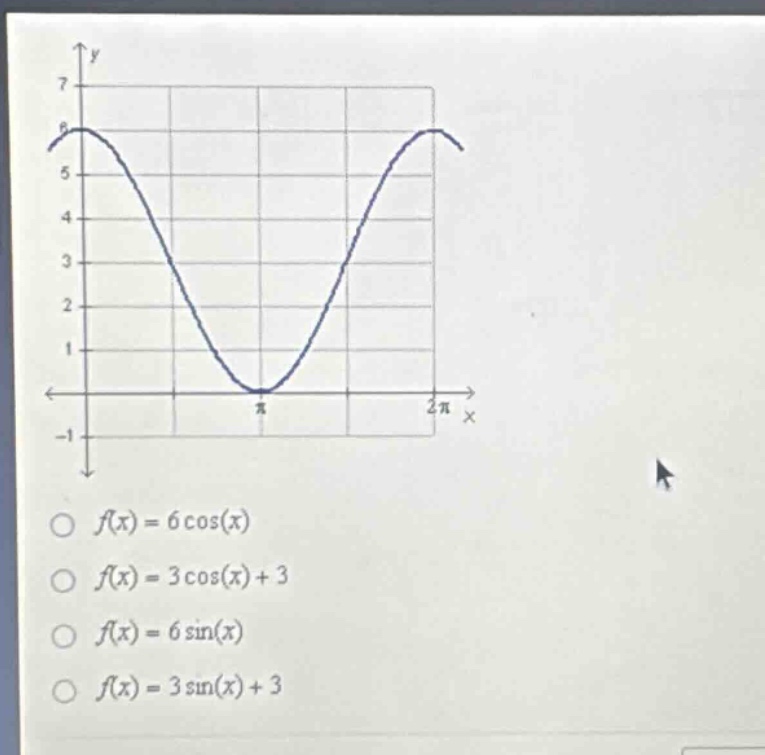
The mid - line of the given graph is $y = 3$. For a function of the form $y = A\sin(x)+D$ or $y = A\cos(x)+D$, the mid - line is $y = D$. So $D = 3$.
Step3: Analyze the amplitude
The amplitude $A$ is the distance from the mid - line to the maximum or minimum value of the function. The maximum value of the function is $y = 6$ and the mid - line is $y = 3$, so $|A|=\frac{6 - 3}{1}=3$.
Step4: Analyze the phase - shift
The graph passes through the point $(0,6)$. For a sine function $y=A\sin(x)+D$, when $x = 0$, $y=A\sin(0)+D=D$. For a cosine function $y = A\cos(x)+D$, when $x = 0$, $y=A\cos(0)+D=A + D$. Since when $x = 0$, $y=6$ and $D = 3$, if we consider $y=A\cos(x)+D$, then $6=A + 3$, so $A = 3$. The function is of the form $y = A\cos(x)+D$ with $A = 3$ and $D = 3$, so $f(x)=3\cos(x)+3$.
Answer:
$f(x)=3\cos(x)+3$