4. f(x)= -6x + 6 f(x)= -3x² + 6x + c c = 3 the graph of f, the derivative of f, is the line shown in the…
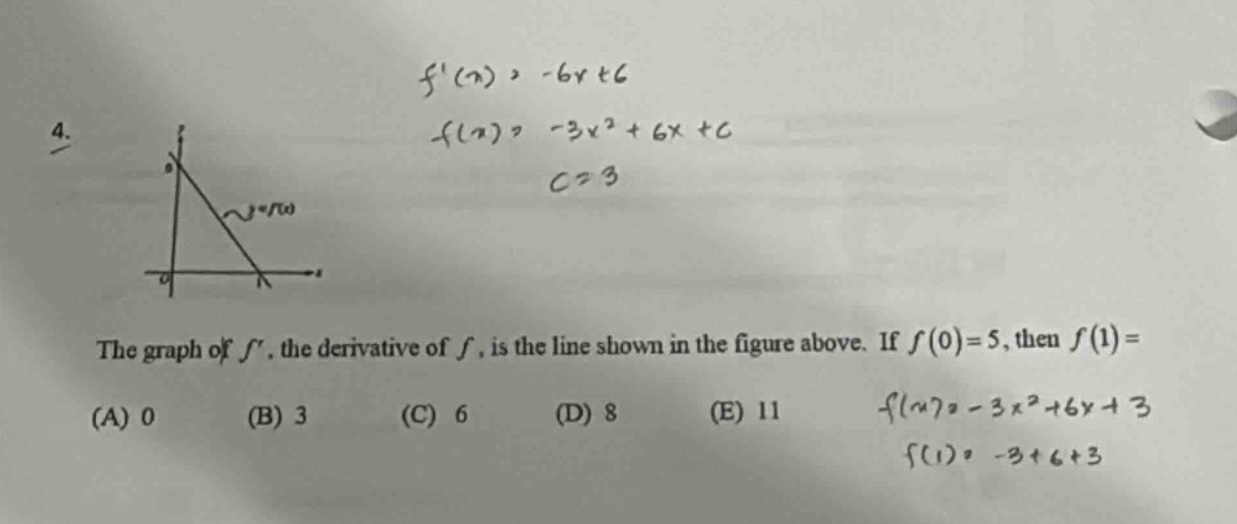
4. f(x)= -6x + 6 f(x)= -3x² + 6x + c c = 3 the graph of f, the derivative of f, is the line shown in the figure above. if f(0)=5, then f(1)= (a) 0 (b) 3 (c) 6 (d) 8 (e) 11 f(x)= -3x² + 6x + 3 f(1)= -3 + 6 + 3
Answer
Explanation:
Step1: Find the antiderivative of (f^{\prime}(x))
Given (f^{\prime}(x)=-6x + 6), the antiderivative (f(x)=\int(-6x + 6)dx=-3x^{2}+6x + C)
Step2: Determine the value of (C)
Since (f(0) = 5), substitute (x = 0) into (f(x)=-3x^{2}+6x + C). We get (f(0)=-3(0)^{2}+6(0)+C=5), so (C = 5)
Step3: Calculate (f(1))
Substitute (x = 1) into (f(x)=-3x^{2}+6x + 5). Then (f(1)=-3(1)^{2}+6(1)+5=-3 + 6+5=8)
Answer:
D. 8