1. if $f(x)=-6x(x - 2)$, then $f(x)$ has a relative minimum at\n(a) $x = 0$ only\n(b) $x = 2$ only\n(c) $x =…
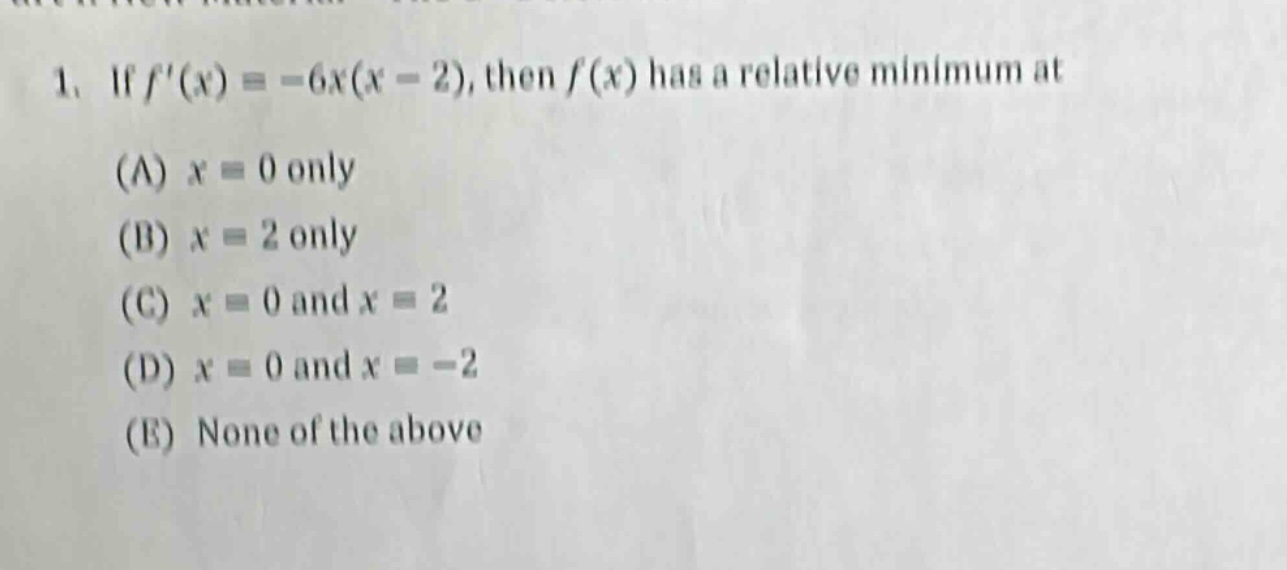
1. if $f(x)=-6x(x - 2)$, then $f(x)$ has a relative minimum at\n(a) $x = 0$ only\n(b) $x = 2$ only\n(c) $x = 0$ and $x = 2$\n(d) $x = 0$ and $x=-2$\n(e) none of the above
Answer
Explanation:
Step1: Find critical points
Set $f'(x)= - 6x(x - 2)=0$. Then $-6x(x - 2)=0$ implies $x = 0$ or $x=2$ since if $ab = 0$, then $a = 0$ or $b = 0$.
Step2: Use the second - derivative test
First, expand $f'(x)=-6x^{2}+12x$. Then find the second - derivative $f''(x)$ by differentiating $f'(x)$ with respect to $x$. Using the power rule $\frac{d}{dx}(ax^{n})=nax^{n - 1}$, we have $f''(x)=\frac{d}{dx}(-6x^{2}+12x)=-12x + 12$.
Step3: Evaluate $f''(x)$ at critical points
When $x = 0$, $f''(0)=-12\times0 + 12=12>0$. When $x = 2$, $f''(2)=-12\times2+12=-12<0$. A function $y = f(x)$ has a relative minimum at a critical point $x = c$ if $f'(c)=0$ and $f''(c)>0$. Since $f'(0)=0$ and $f''(0)>0$, $f(x)$ has a relative minimum at $x = 0$.
Answer:
A. $x = 0$ only