f(x)=x² + 6x + 4\nround to the tenths (on decimal place!)\nrelative maximums (if only one, put n/a in second…
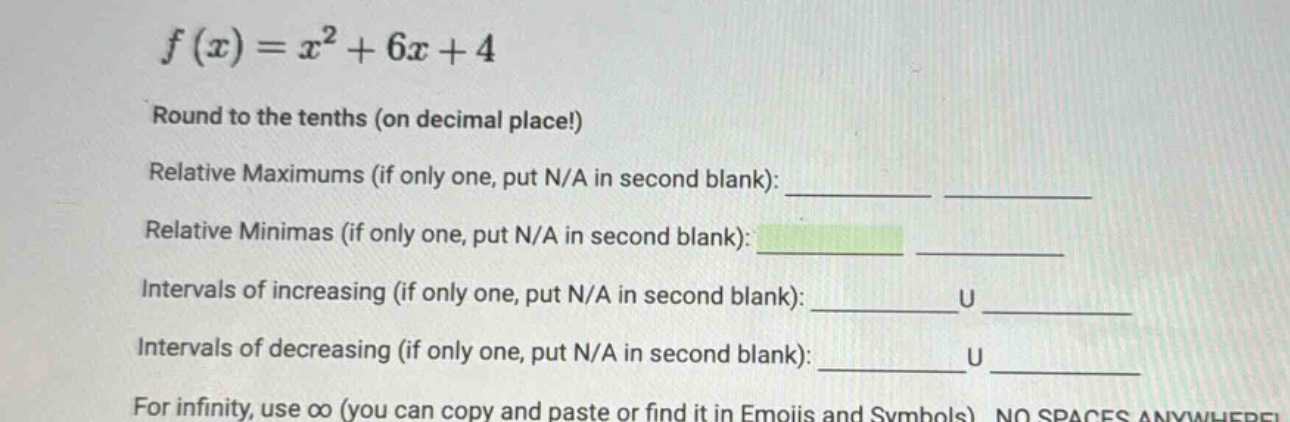
f(x)=x² + 6x + 4\nround to the tenths (on decimal place!)\nrelative maximums (if only one, put n/a in second blank):\nrelative minimas (if only one, put n/a in second blank):\nintervals of increasing (if only one, put n/a in second blank): u\nintervals of decreasing (if only one, put n/a in second blank): u\nfor infinity, use ∞ (you can copy and paste or find it in emojis and symbols) no spaces anywhere
Answer
Explanation:
Step1: Find the derivative
The derivative of $f(x)=x^{2}+6x + 4$ using the power - rule $(x^n)'=nx^{n - 1}$ is $f'(x)=2x+6$.
Step2: Find critical points
Set $f'(x) = 0$. So, $2x+6=0$. Solving for $x$ gives $x=-3$.
Step3: Determine the nature of the critical point
Take the second - derivative $f''(x)$. Since $f'(x)=2x + 6$, then $f''(x)=2>0$. So, the function has a relative minimum at $x=-3$.
Step4: Find the relative minimum value
Substitute $x = - 3$ into $f(x)$: $f(-3)=(-3)^{2}+6\times(-3)+4=9-18 + 4=-5$.
Step5: Find intervals of increase and decrease
If $f'(x)>0$, the function is increasing. Solve $2x+6>0$, we get $x>-3$. If $f'(x)<0$, the function is decreasing. Solve $2x+6<0$, we get $x<-3$.
Answer:
Relative Maximums: N/A N/A Relative Minimums: -3 -5 Intervals of increasing: $(-3,\infty)$ N/A Intervals of decreasing: $(-\infty,-3)$ N/A