77. projectile motion a ball thrown follows a path described by y = x - 0.02x². (a) sketch a graph of the…
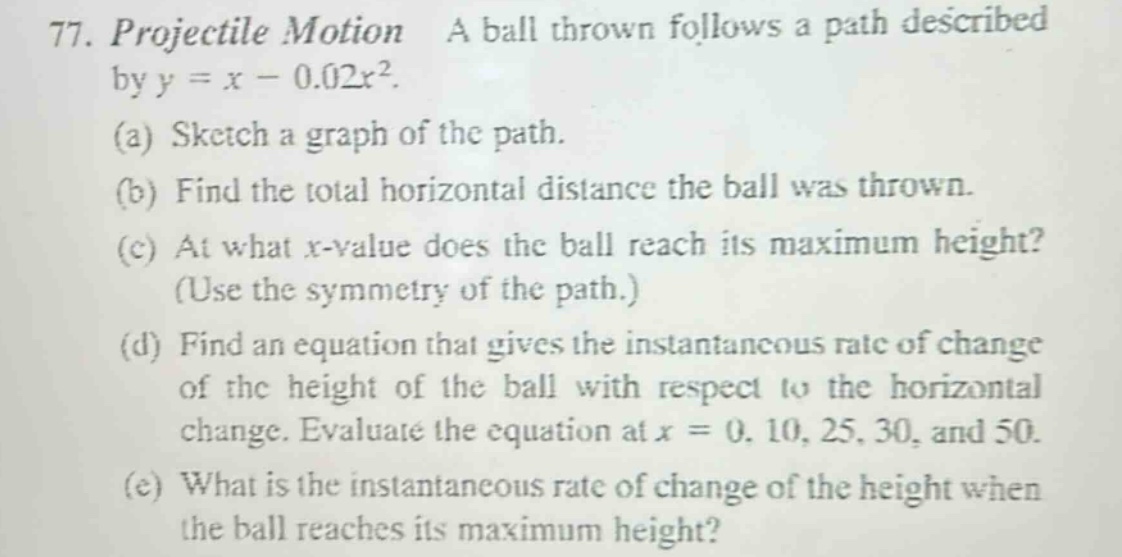
77. projectile motion a ball thrown follows a path described by y = x - 0.02x². (a) sketch a graph of the path. (b) find the total horizontal distance the ball was thrown. (c) at what x - value does the ball reach its maximum height? (use the symmetry of the path.) (d) find an equation that gives the instantaneous rate of change of the height of the ball with respect to the horizontal change. evaluate the equation at x = 0, 10, 25, 30, and 50. (e) what is the instantaneous rate of change of the height when the ball reaches its maximum height?
Answer
Explanation:
Step1: Identify the function type
The function $y = x - 0.02x^{2}$ is a quadratic - function of the form $y=ax^{2}+bx + c$ where $a=-0.02$, $b = 1$, and $c = 0$.
Step2: (a) Sketch the graph
The graph of a quadratic function $y = ax^{2}+bx + c$ is a parabola. Since $a=-0.02<0$, the parabola opens downwards. The $y$-intercept is at $(0,0)$ (when $x = 0$, $y=0$).
Step3: (b) Find the total horizontal distance
The ball hits the ground when $y = 0$. So we set $y=x - 0.02x^{2}=x(1 - 0.02x)=0$. We get $x = 0$ or $1-0.02x=0$. Solving $1-0.02x=0$ gives $x = 50$. The total horizontal distance is $50$ units.
Step4: (c) Find the $x$-value of the maximum
For a quadratic function $y = ax^{2}+bx + c$, the $x$-coordinate of the vertex (maximum for $a<0$) is given by $x=-\frac{b}{2a}$. Substituting $a=-0.02$ and $b = 1$ into $x=-\frac{b}{2a}$, we have $x=-\frac{1}{2\times(-0.02)} = 25$.
Step5: (d) Find the derivative
The instantaneous rate of change of $y$ with respect to $x$ is the derivative $y'$. Using the power - rule $\frac{d}{dx}(x^{n})=nx^{n - 1}$, if $y=x - 0.02x^{2}$, then $y'=1-0.04x$. When $x = 0$, $y'(0)=1-0.04\times0 = 1$. When $x = 10$, $y'(10)=1-0.04\times10=1 - 0.4 = 0.6$. When $x = 25$, $y'(25)=1-0.04\times25=1 - 1 = 0$. When $x = 30$, $y'(30)=1-0.04\times30=1 - 1.2=-0.2$. When $x = 50$, $y'(50)=1-0.04\times50=1 - 2=-1$.
Step6: (e) Instantaneous rate at maximum
At the maximum height, the slope of the tangent line to the curve is $0$. From part (d), when $x = 25$ (the $x$-value of the maximum height), $y'=0$.
Answer:
(a) Sketch a downward - opening parabola passing through the origin. (b) $50$ (c) $25$ (d) $y'=1 - 0.04x$; $y'(0)=1$, $y'(10)=0.6$, $y'(25)=0$, $y'(30)=-0.2$, $y'(50)=-1$ (e) $0$