80. the graph of $f$, the derivative of the function $f$, is shown above. which of the following statements…
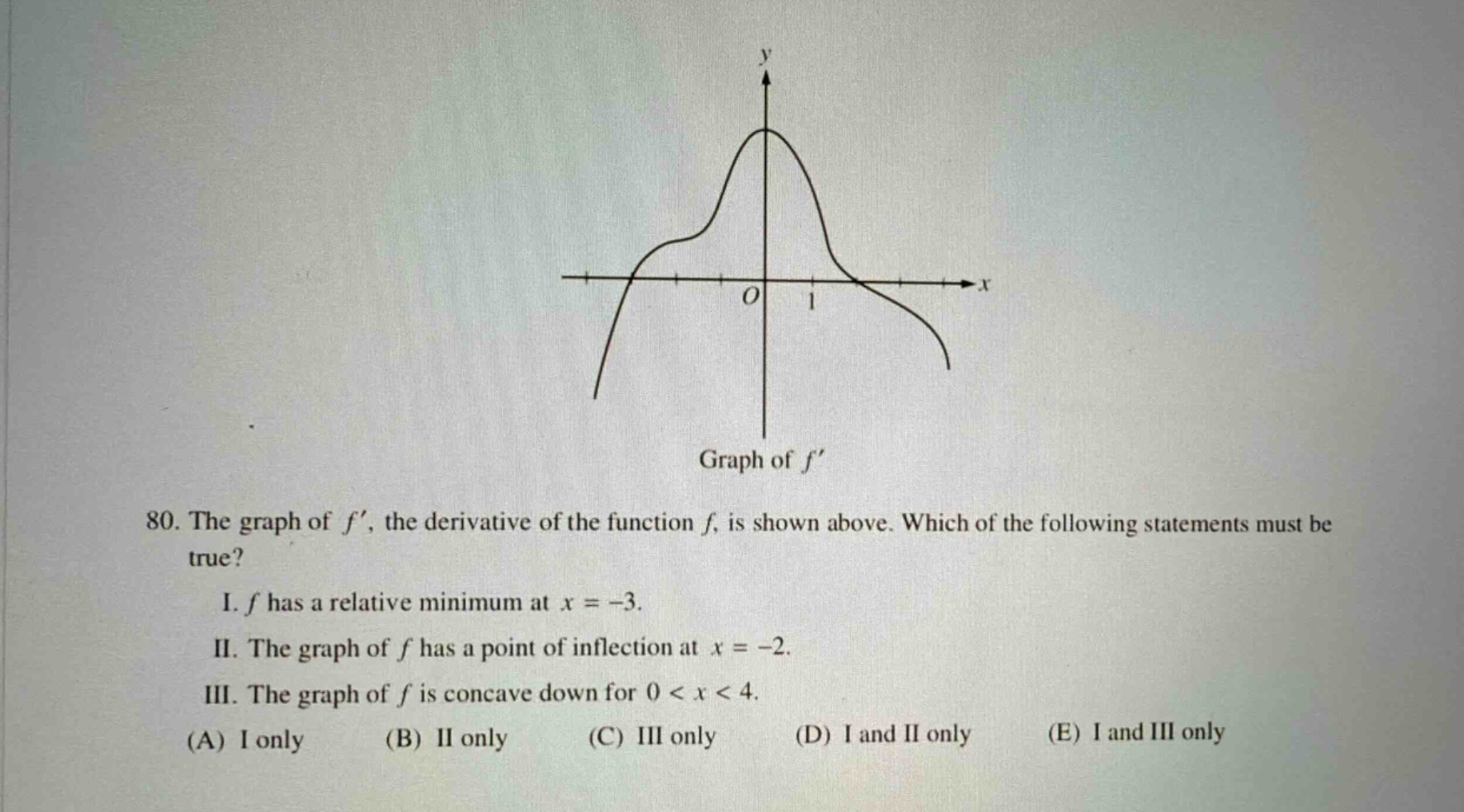
80. the graph of $f$, the derivative of the function $f$, is shown above. which of the following statements must be true?\ni. $f$ has a relative minimum at $x = - 3$.\nii. the graph of $f$ has a point of inflection at $x=-2$.\niii. the graph of $f$ is concave down for $0 < x < 4$.\n(a) i only\n(b) ii only\n(c) iii only\n(d) i and ii only\n(e) i and iii only
Answer
Explanation:
Step1: Analyze relative - minimum condition
A function (y = f(x)) has a relative minimum at (x = c) if (f^{\prime}(c)=0) and (f^{\prime}) changes sign from negative to positive at (x = c). At (x=-3), (f^{\prime}(-3) = 0). To the left of (x = - 3), (f^{\prime}(x)<0) (the graph of (f^{\prime}) is below the (x -)axis), and to the right of (x=-3), (f^{\prime}(x)>0) (the graph of (f^{\prime}) is above the (x -)axis). So (f) has a relative minimum at (x=-3).
Step2: Analyze point - of - inflection condition
A point of inflection of (y = f(x)) occurs where (f^{\prime\prime}(x) = 0) and (f^{\prime\prime}) changes sign. The second - derivative (f^{\prime\prime}(x)) is the derivative of (f^{\prime}(x)). A point of inflection of (f) corresponds to a local maximum or minimum of (f^{\prime}). At (x=-2), (f^{\prime}(x)) has a local maximum. So (f^{\prime\prime}(-2)=0) and (f^{\prime\prime}) changes sign at (x = - 2), and the graph of (f) has a point of inflection at (x=-2).
Step3: Analyze concavity condition
The graph of (y = f(x)) is concave down when (f^{\prime\prime}(x)<0). The second - derivative (f^{\prime\prime}(x)) is the slope of (f^{\prime}(x)). For (0 < x<4), the slope of (f^{\prime}(x)) is negative (the graph of (f^{\prime}(x)) is decreasing), so (f^{\prime\prime}(x)<0) and the graph of (f) is concave down for (0 < x<4).
Answer:
D. I and II only