81. the graph of f is shown in the figure above. if ∫₁³f(x)dx = 2.3 and f(x)=f(x), then f(3)-f(0)=(a) 0.3…
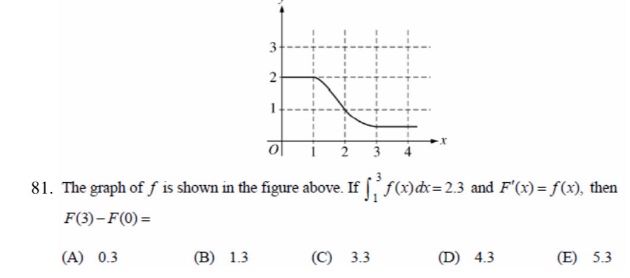
81. the graph of f is shown in the figure above. if ∫₁³f(x)dx = 2.3 and f(x)=f(x), then f(3)-f(0)=(a) 0.3 (b) 1.3 (c) 3.3 (d) 4.3 (e) 5.3
Answer
Explanation:
Step1: Use the fundamental theorem of calculus
By the fundamental theorem of calculus, $\int_{a}^{b}f(x)dx = F(b)-F(a)$ where $F^{\prime}(x)=f(x)$. So $\int_{1}^{3}f(x)dx=F(3) - F(1)=2.3$.
Step2: Find $F(1)-F(0)$
From the graph, for $x\in[0,1]$, $f(x) = 2$. Then $\int_{0}^{1}f(x)dx=\int_{0}^{1}2dx$. Using the integral formula $\int kdx=kx + C$ ($k$ is a constant), we have $\int_{0}^{1}2dx=2x\big|{0}^{1}=2(1)-2(0)=2$. And $\int{0}^{1}f(x)dx=F(1)-F(0)=2$.
Step3: Calculate $F(3)-F(0)$
We know that $F(3)-F(0)=(F(3)-F(1))+(F(1)-F(0))$. Substitute $F(3) - F(1)=2.3$ and $F(1)-F(0)=2$ into the equation. Then $F(3)-F(0)=2.3 + 2=4.3$.
Answer:
(D) 4.3