83. let ( f(x)=int_{a}^{x}h(t)dt ), where ( h ) has the graph shown above. which of the following could be…
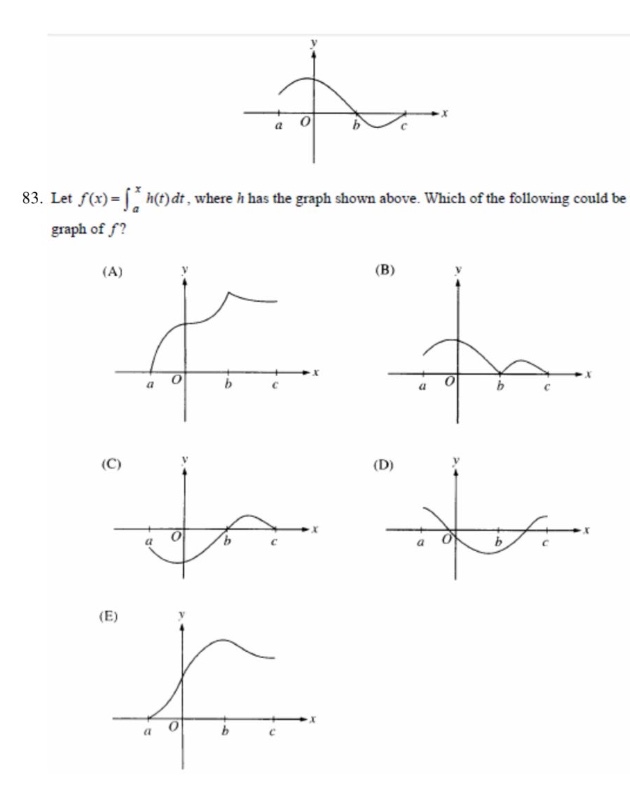
83. let ( f(x)=int_{a}^{x}h(t)dt ), where ( h ) has the graph shown above. which of the following could be the graph of ( f )? (a) (b) (c) (d) (e)
Answer
Explanation:
Step1: Recall the fundamental theorem of calculus
By the fundamental - theorem of calculus, $f^\prime(x)=h(x)$. The sign of $h(x)$ determines the increasing or decreasing behavior of $f(x)$.
Step2: Analyze the sign of $h(x)$ on $[a,b]$
On the interval $[a,b]$, $h(x)>0$. So, $f^\prime(x)>0$ on $[a,b]$, which means $f(x)$ is increasing on $[a,b]$.
Step3: Analyze the sign of $h(x)$ on $[b,c]$
On the interval $[b,c]$, $h(x)<0$. So, $f^\prime(x)<0$ on $[b,c]$, which means $f(x)$ is decreasing on $[b,c]$.
Step4: Analyze the concavity of $f(x)$
The concavity of $f(x)$ is determined by the sign of $f^{\prime\prime}(x)$. Since $f^{\prime\prime}(x) = h^\prime(x)$. When $h(x)$ is increasing, $f^{\prime\prime}(x)>0$ and $f(x)$ is concave - up; when $h(x)$ is decreasing, $f^{\prime\prime}(x)<0$ and $f(x)$ is concave - down.
Step5: Evaluate the options
Option (A) is correct because it is increasing on $[a,b]$ and decreasing on $[b,c]$. Option (B) is increasing on $[a,b]$ but then increases again on $[b,c]$, so it's wrong. Option (C) is decreasing on $[a,b]$, so it's wrong. Option (D) has wrong increasing - decreasing behavior. Option (E) has wrong concavity and increasing - decreasing behavior.
Answer:
A.