89. the function f is continuous for -2 ≤ x ≤ 2 and f(-2) = f(2) = 0. if there is no c, where -2 < c < 2…
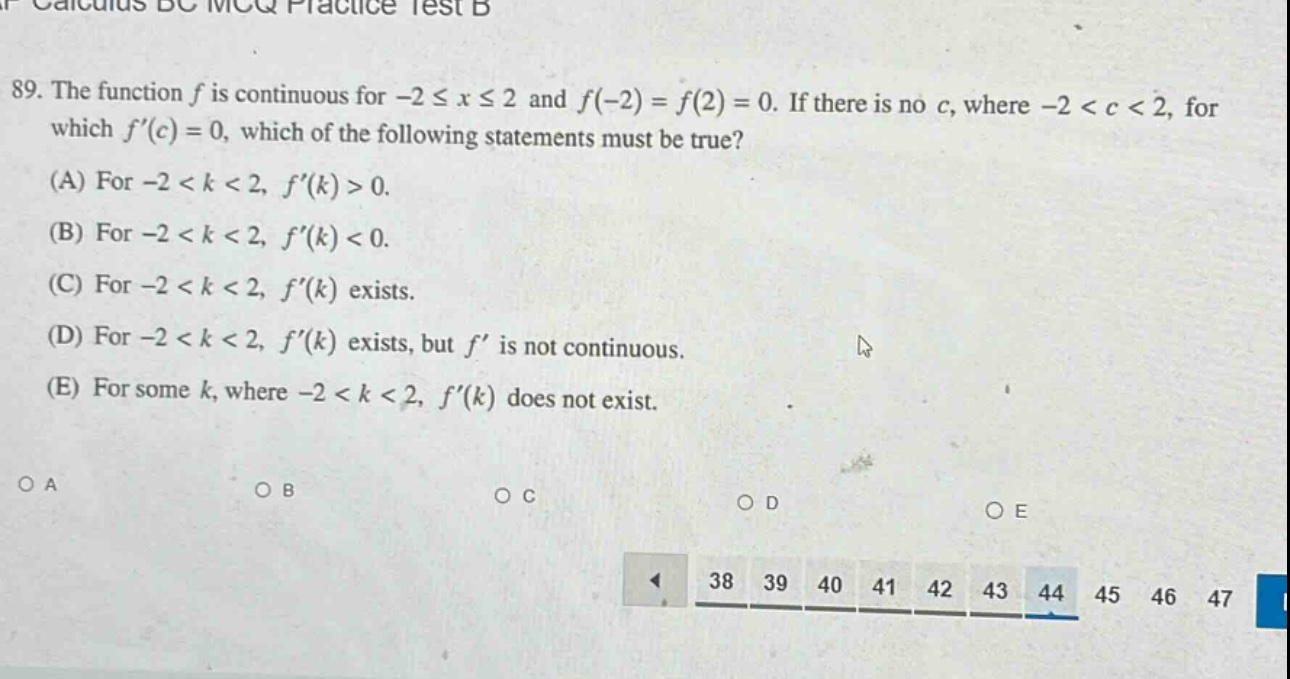
89. the function f is continuous for -2 ≤ x ≤ 2 and f(-2) = f(2) = 0. if there is no c, where -2 < c < 2, for which f(c) = 0, which of the following statements must be true? (a) for -2 < k < 2, f(k) > 0. (b) for -2 < k < 2, f(k) < 0. (c) for -2 < k < 2, f(k) exists. (d) for -2 < k < 2, f(k) exists, but f is not continuous. (e) for some k, where -2 < k < 2, f(k) does not exist. o a o b o c o d o e 38 39 40 41 42 43 44 45 46 47
Answer
Explanation:
Step1: Recall Rolle's theorem
Rolle's theorem states that if a function $y = f(x)$ is continuous on $[a,b]$, differentiable on $(a,b)$ and $f(a)=f(b)$, then there exists at least one $c\in(a,b)$ such that $f^{\prime}(c) = 0$.
Step2: Analyze the given conditions
Here, $f(x)$ is continuous on $[- 2,2]$, $f(-2)=f(2) = 0$, but there is no $c\in(-2,2)$ such that $f^{\prime}(c)=0$. The only way this can happen is if the function is not differentiable at some point in the open - interval $(-2,2)$.
Step3: Evaluate each option
- Option A: Just because there is no $c$ with $f^{\prime}(c)=0$ does not mean $f^{\prime}(k)>0$ for all $k\in(-2,2)$. The function could be decreasing in some parts.
- Option B: Similarly, it does not mean $f^{\prime}(k)<0$ for all $k\in(-2,2)$.
- Option C: If $f^{\prime}(k)$ exists for all $k\in(-2,2)$, then by Rolle's theorem, there would be a $c$ such that $f^{\prime}(c)=0$.
- Option D: If $f^{\prime}(k)$ exists for all $k\in(-2,2)$, Rolle's theorem would apply.
- Option E: Since Rolle's theorem does not hold and the function is continuous on $[-2,2]$ with $f(-2)=f(2) = 0$, for some $k\in(-2,2)$, $f^{\prime}(k)$ must not exist.
Answer:
E. For some $k$, where $-2 < k < 2$, $f^{\prime}(k)$ does not exist.