o y = 8cos(x)+3\no y = 4cos(x)+3\no y = 4sin(x)+3\no y = 8sin(x)+3\nmark this and return
o y = 8cos(x)+3\no y = 4cos(x)+3\no y = 4sin(x)+3\no y = 8sin(x)+3\nmark this and return
Answer
Answer:
B. $y = 4\cos(x)+3$
Explanation:
Step1: Identify the general form
The general form of a cosine - sine function is $y = A\sin(x - h)+k$ or $y=A\cos(x - h)+k$, where $|A|$ is the amplitude, $h$ is the phase - shift, and $k$ is the vertical shift.
Step2: Determine the vertical shift
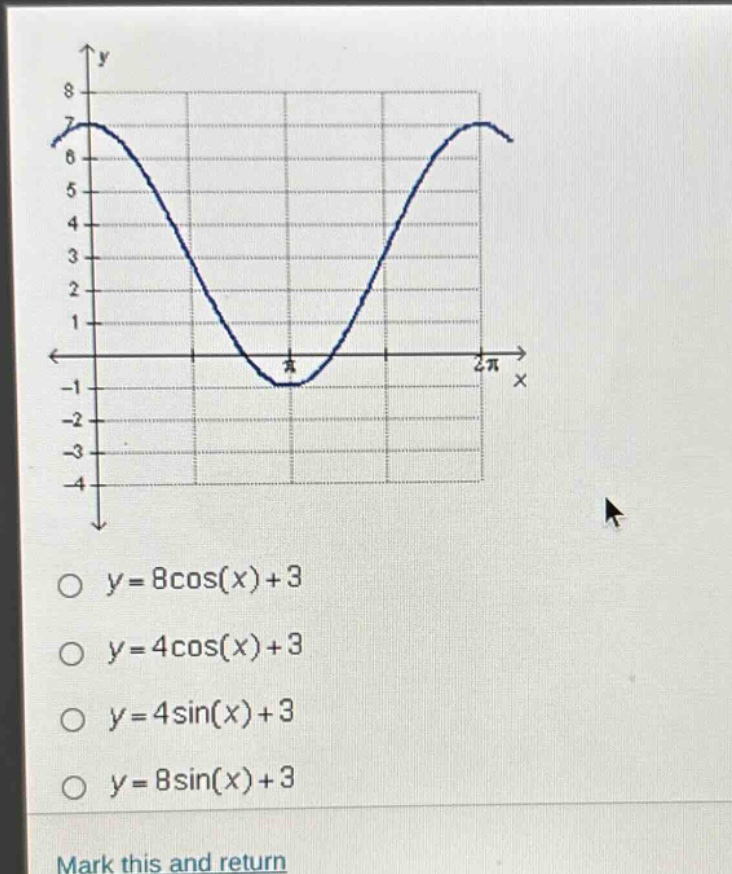
The mid - line of the graph is at $y = 3$. So, $k = 3$.
Step3: Calculate the amplitude
The maximum value of the function is $y = 7$ and the minimum value is $y=- 1$. The amplitude $A=\frac{\text{max}-\text{min}}{2}=\frac{7 - (-1)}{2}=\frac{8}{2}=4$.
Step4: Check the phase - shift
The graph of $y = A\cos(x - h)+k$ or $y = A\sin(x - h)+k$ passes through the point $(0,7)$. For $y = A\cos(x - h)+k$, when $x = 0$, $y=A\cos(-h)+k$. For $y = A\sin(x - h)+k$, when $x = 0$, $y=A\sin(-h)+k$. If we consider the cosine function $y = A\cos(x)+k$ (assuming $h = 0$), substituting $x = 0$, $y=A\cos(0)+k$. Since $\cos(0)=1$, when $A = 4$ and $k = 3$, $y=4\times1 + 3=7$. If we consider the sine function $y = A\sin(x)+k$, when $x = 0$, $y=A\sin(0)+k=k$. Since $k = 3\neq7$ when $x = 0$ for the sine function with no phase - shift, the function is $y = 4\cos(x)+3$.