g(x)=8g(x), and g(2)=7. solve the equation. choose 1 answer: a g(x)=7e^{2x + 8} b g(x)=e^{8x}+7 c…
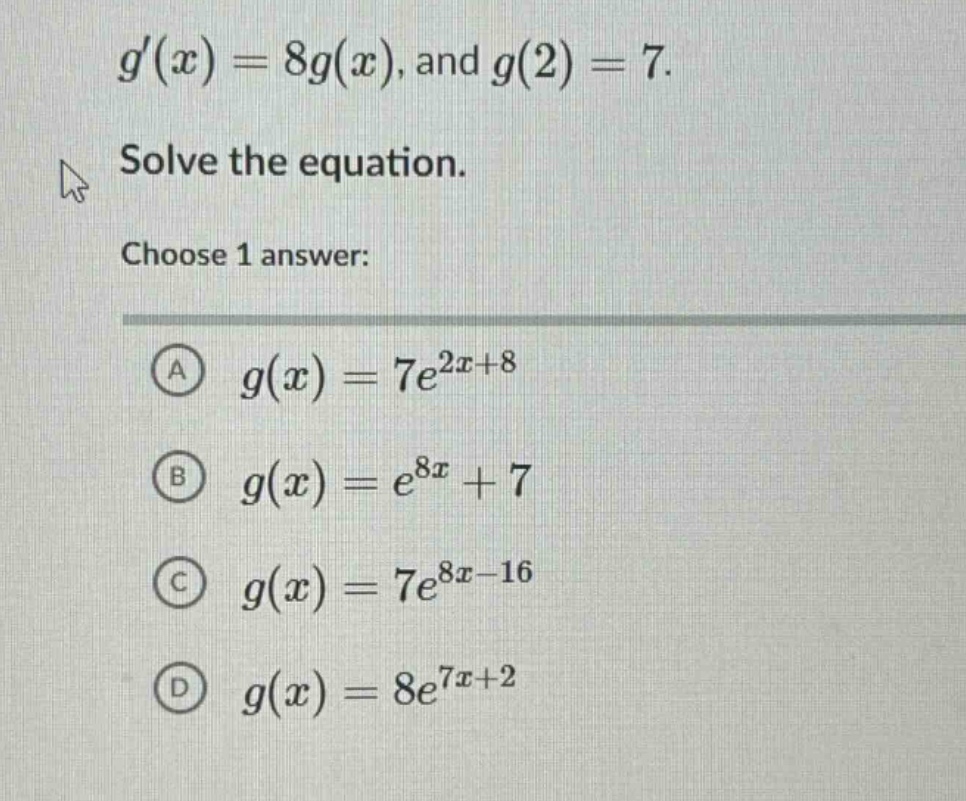
g(x)=8g(x), and g(2)=7. solve the equation. choose 1 answer: a g(x)=7e^{2x + 8} b g(x)=e^{8x}+7 c g(x)=7e^{8x - 16} d g(x)=8e^{7x+2}
Answer
Explanation:
Step1: Identify the differential - equation type
The given differential equation $g'(x)=8g(x)$ is a first - order separable differential equation of the form $\frac{dy}{dx}=ky$, where $k = 8$. The general solution of $\frac{dy}{dx}=ky$ is $y = Ce^{kx}$, where $C$ is a constant.
Step2: Find the general solution
For $g'(x)=8g(x)$, the general solution is $g(x)=Ce^{8x}$.
Step3: Use the initial condition
We know that $g(2)=7$. Substitute $x = 2$ and $g(x)=7$ into $g(x)=Ce^{8x}$. So, $7=Ce^{8\times2}=Ce^{16}$. Solving for $C$, we get $C = 7e^{-16}$.
Step4: Write the particular solution
Substitute $C = 7e^{-16}$ into $g(x)=Ce^{8x}$, we have $g(x)=7e^{-16}\times e^{8x}=7e^{8x - 16}$.
Answer:
C. $g(x)=7e^{8x - 16}$