1.92/6.25 points details my notes this question has several parts that must be completed sequentially. if…
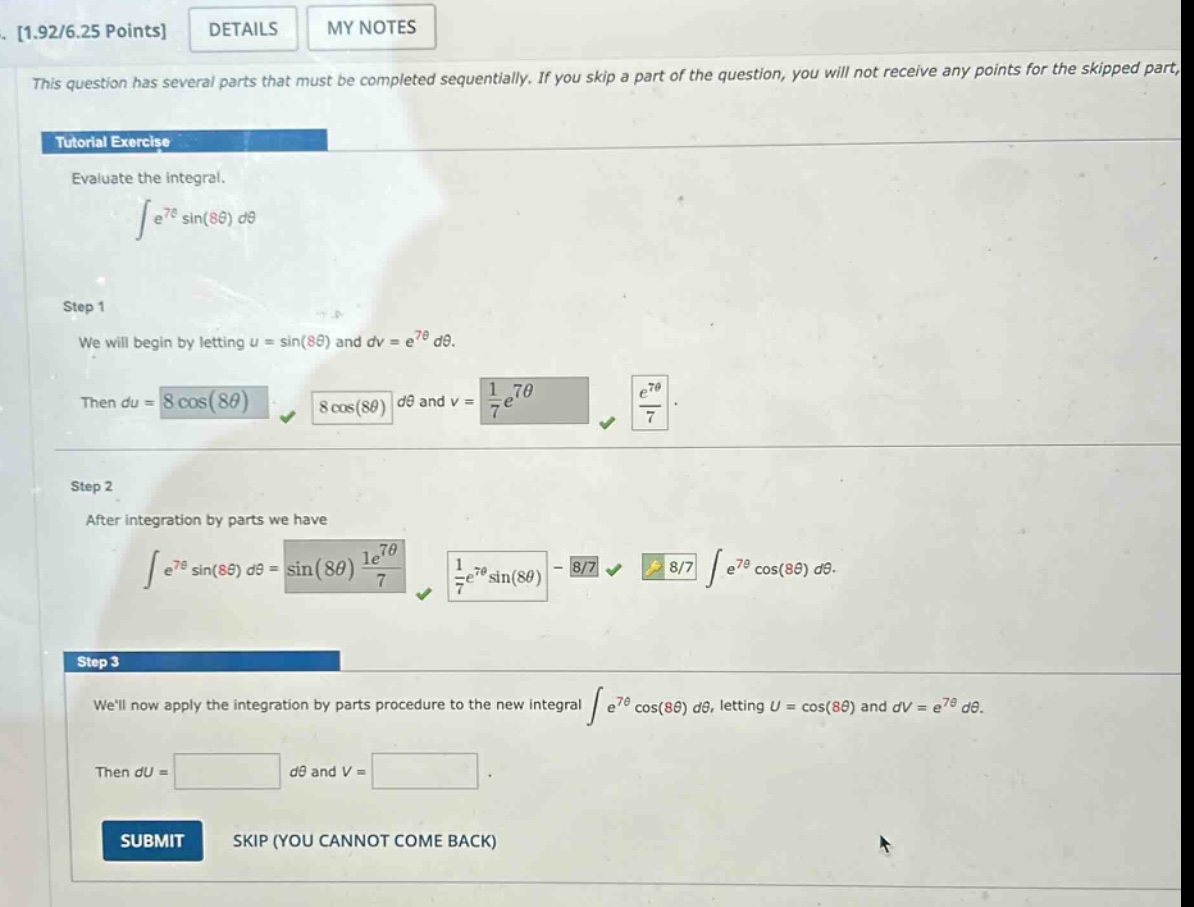
1.92/6.25 points details my notes this question has several parts that must be completed sequentially. if you skip a part of the question, you will not receive any points for the skipped part, tutorial exercise evaluate the integral. ∫e^7θ sin(8θ) dθ step 1 we will begin by letting u = sin(8θ) and dv = e^7θ dθ. then du = 8 cos(8θ) dθ and v = 1/7 e^7θ. step 2 after integration by parts we have ∫e^7θ sin(8θ) dθ = sin(8θ) 1/7 e^7θ - 8/7 ∫e^7θ cos(8θ) dθ. step 3 well now apply the integration by parts procedure to the new integral ∫e^7θ cos(8θ) dθ, letting u = cos(8θ) and dv = e^7θ dθ. then du = dθ and v = . submit skip (you cannot come back)
Answer
Explanation:
Step1: Differentiate $U = \cos(8\theta)$
Using the chain - rule, if $y=\cos(8\theta)$, let $u = 8\theta$, then $y=\cos(u)$. The derivative of $y$ with respect to $u$ is $-\sin(u)$ and the derivative of $u$ with respect to $\theta$ is $8$. So, $dU=- 8\sin(8\theta)d\theta$.
Step2: Integrate $dV = e^{7\theta}d\theta$
The integral of $e^{ax}$ with respect to $x$ is $\frac{1}{a}e^{ax}+C$. Here $a = 7$, so $V=\frac{1}{7}e^{7\theta}$.
Answer:
$dU=-8\sin(8\theta)d\theta$, $V = \frac{1}{7}e^{7\theta}$