f(x)=x^3 - 9x\nover which interval does f have a positive average rate of change?\nchoose 1 answer:\na…
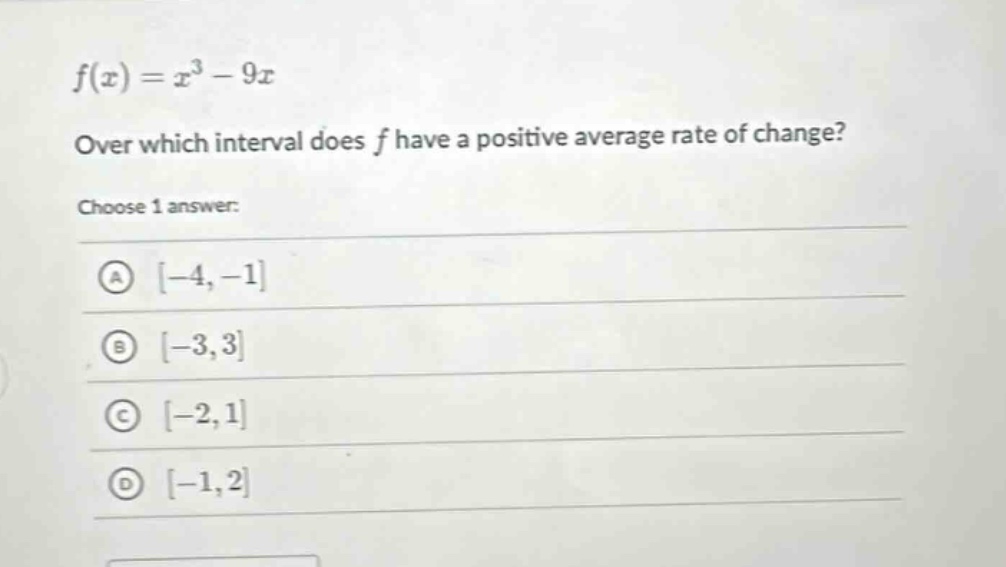
f(x)=x^3 - 9x\nover which interval does f have a positive average rate of change?\nchoose 1 answer:\na -4,-1\nb -3,3\nc -2,1\nd -1,2
Answer
Explanation:
Step1: Recall average - rate - of - change formula
The average rate of change of a function $y = f(x)$ over the interval $[a,b]$ is $\frac{f(b)-f(a)}{b - a}$.
Step2: Calculate for option A
For $f(x)=x^{3}-9x$ and the interval $[a=-4,b = - 1]$. $f(-4)=(-4)^{3}-9\times(-4)=-64 + 36=-28$. $f(-1)=(-1)^{3}-9\times(-1)=-1 + 9 = 8$. The average rate of change is $\frac{f(-1)-f(-4)}{-1-(-4)}=\frac{8-(-28)}{-1 + 4}=\frac{36}{3}=12>0$.
Step3: Calculate for option B
For the interval $[a=-3,b = 3]$. $f(-3)=(-3)^{3}-9\times(-3)=-27+27 = 0$. $f(3)=3^{3}-9\times3=27 - 27=0$. The average rate of change is $\frac{f(3)-f(-3)}{3-(-3)}=\frac{0 - 0}{6}=0$.
Step4: Calculate for option C
For the interval $[a=-2,b = 1]$. $f(-2)=(-2)^{3}-9\times(-2)=-8 + 18 = 10$. $f(1)=1^{3}-9\times1=1 - 9=-8$. The average rate of change is $\frac{f(1)-f(-2)}{1-(-2)}=\frac{-8 - 10}{3}=\frac{-18}{3}=-6<0$.
Step5: Calculate for option D
For the interval $[a=-1,b = 2]$. $f(-1)=(-1)^{3}-9\times(-1)=-1 + 9 = 8$. $f(2)=2^{3}-9\times2=8 - 18=-10$. The average rate of change is $\frac{f(2)-f(-1)}{2-(-1)}=\frac{-10 - 8}{3}=\frac{-18}{3}=-6<0$.
Answer:
A. $[-4,-1]$