a4 find the half - range fourier sine series expansion for the function f(x)=x(l - x), for 0 < x < l…
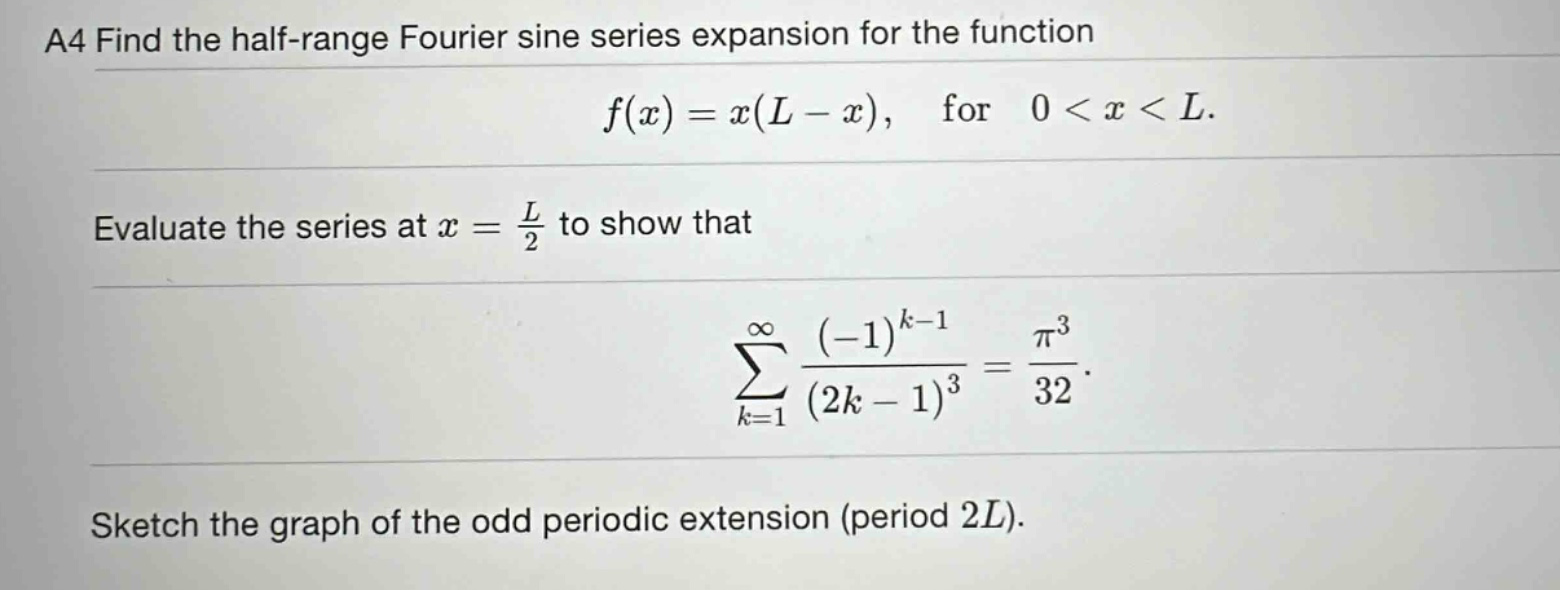
a4 find the half - range fourier sine series expansion for the function f(x)=x(l - x), for 0 < x < l. evaluate the series at x = l/2 to show that sum(k = 1 to infinity) ((-1)^(k - 1))/((2k - 1)^3)=pi^3/32. sketch the graph of the odd periodic extension (period 2l).
Answer
Explanation:
Step1: Recall Fourier - sine series formula
The half - range Fourier sine series of a function $f(x)$ on the interval $(0,L)$ is given by $f(x)=\sum_{n = 1}^{\infty}b_{n}\sin(\frac{n\pi x}{L})$, where $b_{n}=\frac{2}{L}\int_{0}^{L}f(x)\sin(\frac{n\pi x}{L})dx$.
Step2: Calculate $b_{n}$ for $f(x)=x(L - x)$
[ \begin{align*} b_{n}&=\frac{2}{L}\int_{0}^{L}x(L - x)\sin(\frac{n\pi x}{L})dx\ &=\frac{2}{L}\left(L\int_{0}^{L}x\sin(\frac{n\pi x}{L})dx-\int_{0}^{L}x^{2}\sin(\frac{n\pi x}{L})dx\right) \end{align*} ] Use integration by parts. Let $u = x$, $dv=\sin(\frac{n\pi x}{L})dx$, then $du = dx$, $v=-\frac{L}{n\pi}\cos(\frac{n\pi x}{L})$ for the first integral. And for $\int x^{2}\sin(\frac{n\pi x}{L})dx$, use integration by parts twice. After calculation, we get $b_{n}=\frac{4L^{2}}{\pi^{3}n^{3}}[1-(- 1)^{n}]$. When $n = 2k$ (even), $b_{2k}=0$; when $n = 2k - 1$ (odd), $b_{2k - 1}=\frac{8L^{2}}{\pi^{3}(2k - 1)^{3}}$. So $f(x)=\sum_{k = 1}^{\infty}\frac{8L^{2}}{\pi^{3}(2k - 1)^{3}}\sin(\frac{(2k - 1)\pi x}{L})$.
Step3: Evaluate the series at $x=\frac{L}{2}$
Substitute $x = \frac{L}{2}$ into $f(x)=\sum_{k = 1}^{\infty}\frac{8L^{2}}{\pi^{3}(2k - 1)^{3}}\sin(\frac{(2k - 1)\pi x}{L})$. We have $f(\frac{L}{2})=\frac{L}{2}(L-\frac{L}{2})=\frac{L^{2}}{4}$, and $\sin(\frac{(2k - 1)\pi}{2})=(-1)^{k - 1}$. Then $\frac{L^{2}}{4}=\sum_{k = 1}^{\infty}\frac{8L^{2}}{\pi^{3}(2k - 1)^{3}}(-1)^{k - 1}$. After simplification, $\sum_{k = 1}^{\infty}\frac{(-1)^{k - 1}}{(2k - 1)^{3}}=\frac{\pi^{3}}{32}$.
Step4: Sketch the odd - periodic extension
The function $y = f(x)=x(L - x)$ on $(0,L)$ is a parabola opening downwards with vertex at $x=\frac{L}{2}$ and $y=\frac{L^{2}}{4}$. The odd - periodic extension of $y = f(x)$ with period $2L$ is symmetric about the origin. For $-L\lt x\lt0$, $f(x)=-f(-x)=-(-x)(L + x)=x(L + x)$. And then we can repeat this pattern with period $2L$ to get the whole graph.
Answer:
The half - range Fourier sine series of $f(x)$ is $f(x)=\sum_{k = 1}^{\infty}\frac{8L^{2}}{\pi^{3}(2k - 1)^{3}}\sin(\frac{(2k - 1)\pi x}{L})$, and the proof of $\sum_{k = 1}^{\infty}\frac{(-1)^{k - 1}}{(2k - 1)^{3}}=\frac{\pi^{3}}{32}$ is shown above, and the odd - periodic extension graph is described as above.