the acceleration y, in meters per second squared, of an object after x seconds is given by y = 7 sin(π/4 x)…
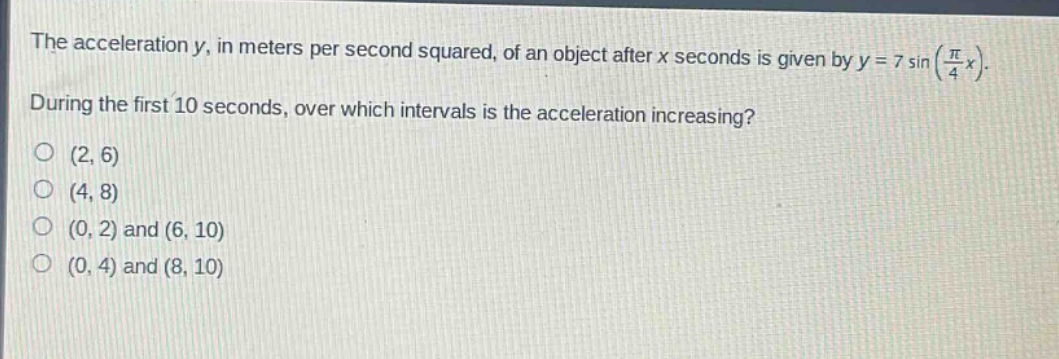
the acceleration y, in meters per second squared, of an object after x seconds is given by y = 7 sin(π/4 x). during the first 10 seconds, over which intervals is the acceleration increasing? (2, 6) (4, 8) (0, 2) and (6, 10) (0, 4) and (8, 10)
Answer
Explanation:
Step1: Find the derivative of $y$
We know that if $y = 7\sin(\frac{\pi}{4}x)$, using the chain - rule. If $y = A\sin(u)$ and $u = Bx$ ($A = 7$, $B=\frac{\pi}{4}$), then $y^\prime=A\cdot B\cos(u)$. So $y^\prime=\frac{7\pi}{4}\cos(\frac{\pi}{4}x)$.
Step2: Determine when $y^\prime>0$
We want to find when $\frac{7\pi}{4}\cos(\frac{\pi}{4}x)>0$. Since $\frac{7\pi}{4}>0$, we just need to find when $\cos(\frac{\pi}{4}x)>0$. The general solution for $\cos(t)>0$ is $2k\pi-\frac{\pi}{2}<t<2k\pi + \frac{\pi}{2},k\in\mathbb{Z}$. Substituting $t = \frac{\pi}{4}x$, we get $2k\pi-\frac{\pi}{2}<\frac{\pi}{4}x<2k\pi+\frac{\pi}{2}$.
Step3: Solve the inequality for $x$
First, multiply each part of the inequality $2k\pi-\frac{\pi}{2}<\frac{\pi}{4}x<2k\pi+\frac{\pi}{2}$ by $\frac{4}{\pi}$. We have $8k - 2<x<8k + 2$.
Step4: Find the intervals for $0\leq x\leq10$
When $k = 0$, $- 2<x<2$. Since we are considering $0\leq x\leq10$, the relevant part is $0\leq x<2$. When $k = 1$, $8 - 2<x<8 + 2$, i.e., $6<x<10$.
Answer:
C. $(0, 2)$ and $(6, 10)$