according to the table, which ordered pair is a local minimum of the function, f(x)?\no (0, 9)\no (4…
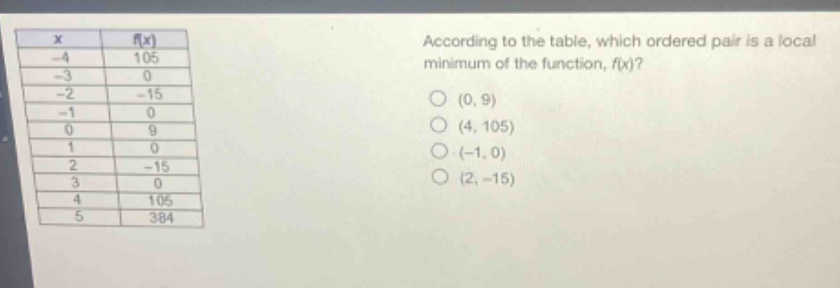
according to the table, which ordered pair is a local minimum of the function, f(x)?\no (0, 9)\no (4, 105)\no (-1, 0)\no (2, -15)\n\nx f(x)\n-4 105\n-3 0\n-2 -15\n-1 0\n0 9\n1 0\n2 -15\n3 0\n4 105\n5 384
Answer
Answer:
(2, -15)
Explanation:
Step1: Understand local minimum
A local minimum is a point where the function value is less than the values at neighboring points.
Step2: Check values around points
For (x = 0), (f(0)=9), (f(- 1)=0), (f(1)=0), so ((0,9)) is not a local - minimum. For (x = 4), (f(4)=105), (f(3)=0), so ((4,105)) is not a local - minimum. For (x=-1), (f(-1)=0), (f(-2)= - 15), so ((-1,0)) is not a local - minimum. For (x = 2), (f(2)=-15), (f(1)=0), (f(3)=0). Since (-15<0), the function value at (x = 2) is less than the function values at its neighboring points (x = 1) and (x = 3). So ((2,-15)) is a local minimum.