al exercise\nfind the taylor series for f(x) centered at the given value of a. assume that f has a power…
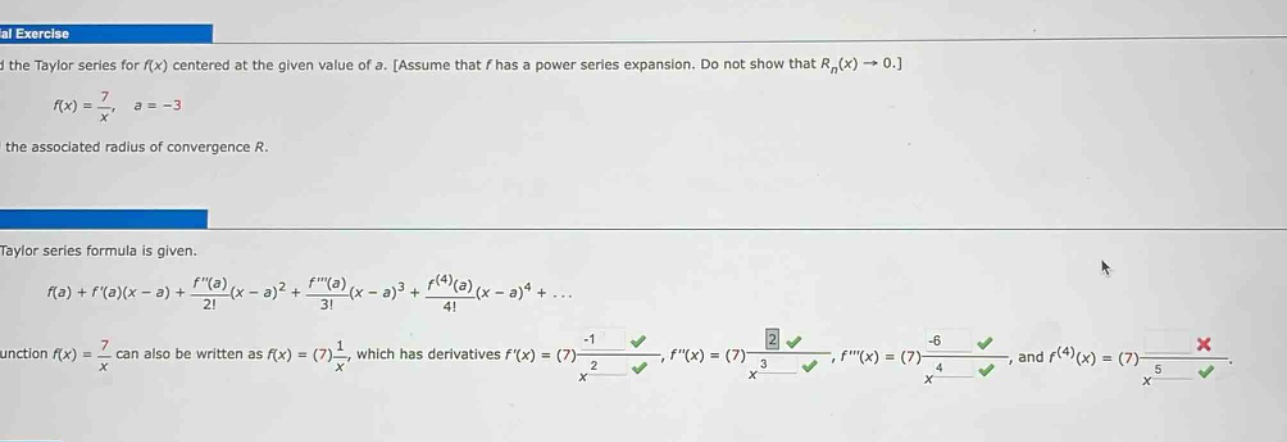
al exercise\nfind the taylor series for f(x) centered at the given value of a. assume that f has a power series expansion. do not show that r_n(x)→0.\nf(x)=7/x, a = - 3\nfind the associated radius of convergence r.\ntaylor series formula is given.\nf(a)+f(a)(x - a)+f(a)/2!(x - a)^2+f(a)/3!(x - a)^3+f^(4)(a)/4!(x - a)^4+...\nfunction f(x)=7/x can also be written as f(x)=(7)1/x, which has derivatives f(x)=(7)-1/x^2, f(x)=(7)2/x^3, f(x)=(7)-6/x^4, and f^(4)(x)=(7)?
Answer
Explanation:
Step1: Find derivatives of (f(x))
Given (f(x)=\frac{7}{x}=7x^{-1}), (a = - 3). The first - derivative (f^{\prime}(x)=7\times(-1)x^{-2}=-\frac{7}{x^{2}}). The second - derivative (f^{\prime\prime}(x)=7\times(-1)\times(-2)x^{-3}=\frac{14}{x^{3}}). The third - derivative (f^{\prime\prime\prime}(x)=7\times(-1)\times(-2)\times(-3)x^{-4}=-\frac{42}{x^{4}}). The (n) - th derivative (f^{(n)}(x)=7\times(-1)^{n}n!x^{-(n + 1)}).
Step2: Evaluate derivatives at (a=-3)
(f(-3)=-\frac{7}{3}), (f^{\prime}(-3)=-\frac{7}{9}), (f^{\prime\prime}(-3)=\frac{14}{27}), (f^{\prime\prime\prime}(-3)=-\frac{42}{81}), (f^{(n)}(-3)=7\times(-1)^{n}n!\times(-3)^{-(n + 1)}).
Step3: Write the Taylor series
Using the Taylor series formula (f(x)=\sum_{n = 0}^{\infty}\frac{f^{(n)}(a)}{n!}(x - a)^{n}), we have: [ \begin{align*} f(x)&=f(-3)+f^{\prime}(-3)(x + 3)+\frac{f^{\prime\prime}(-3)}{2!}(x + 3)^{2}+\frac{f^{\prime\prime\prime}(-3)}{3!}(x + 3)^{3}+\cdots+\frac{f^{(n)}(-3)}{n!}(x + 3)^{n}+\cdots\ &=-\frac{7}{3}-\frac{7}{9}(x + 3)+\frac{14}{27\times2}(x + 3)^{2}-\frac{42}{81\times6}(x + 3)^{3}+\cdots+\frac{7\times(-1)^{n}n!}{n!\times(-3)^{n + 1}}(x + 3)^{n}+\cdots\ &=-\frac{7}{3}-\frac{7}{9}(x + 3)+\frac{7}{27}(x + 3)^{2}-\frac{7}{81}(x + 3)^{3}+\cdots+\frac{7\times(-1)^{n}}{(-3)^{n+1}}(x + 3)^{n}+\cdots\ &=\sum_{n = 0}^{\infty}\frac{7\times(-1)^{n}}{(-3)^{n + 1}}(x + 3)^{n} \end{align*} ]
Step4: Find the radius of convergence
Use the ratio test. Let (u_{n}=\frac{7\times(-1)^{n}}{(-3)^{n + 1}}(x + 3)^{n}). Then (u_{n+1}=\frac{7\times(-1)^{n+1}}{(-3)^{n + 2}}(x + 3)^{n+1}). [ \begin{align*} \lim_{n\rightarrow\infty}\left|\frac{u_{n + 1}}{u_{n}}\right|&=\lim_{n\rightarrow\infty}\left|\frac{\frac{7\times(-1)^{n+1}}{(-3)^{n + 2}}(x + 3)^{n+1}}{\frac{7\times(-1)^{n}}{(-3)^{n + 1}}(x + 3)^{n}}\right|\ &=\lim_{n\rightarrow\infty}\left|\frac{(-1)^{n+1}}{(-1)^{n}}\cdot\frac{(-3)^{n + 1}}{(-3)^{n + 2}}\cdot(x + 3)\right|\ &=\lim_{n\rightarrow\infty}\left|(-1)\times\left(-\frac{1}{3}\right)\times(x + 3)\right|\ &=\left|\frac{x + 3}{3}\right| \end{align*} ] For convergence, (\left|\frac{x + 3}{3}\right|\lt1), so (|x+3|\lt3). The radius of convergence (R = 3).
Answer:
The Taylor series is (\sum_{n = 0}^{\infty}\frac{7\times(-1)^{n}}{(-3)^{n + 1}}(x + 3)^{n}) and the radius of convergence (R = 3).