algebraically determine whether the function f(x)=6√cos⁶x is periodic. if it is, determine its period…
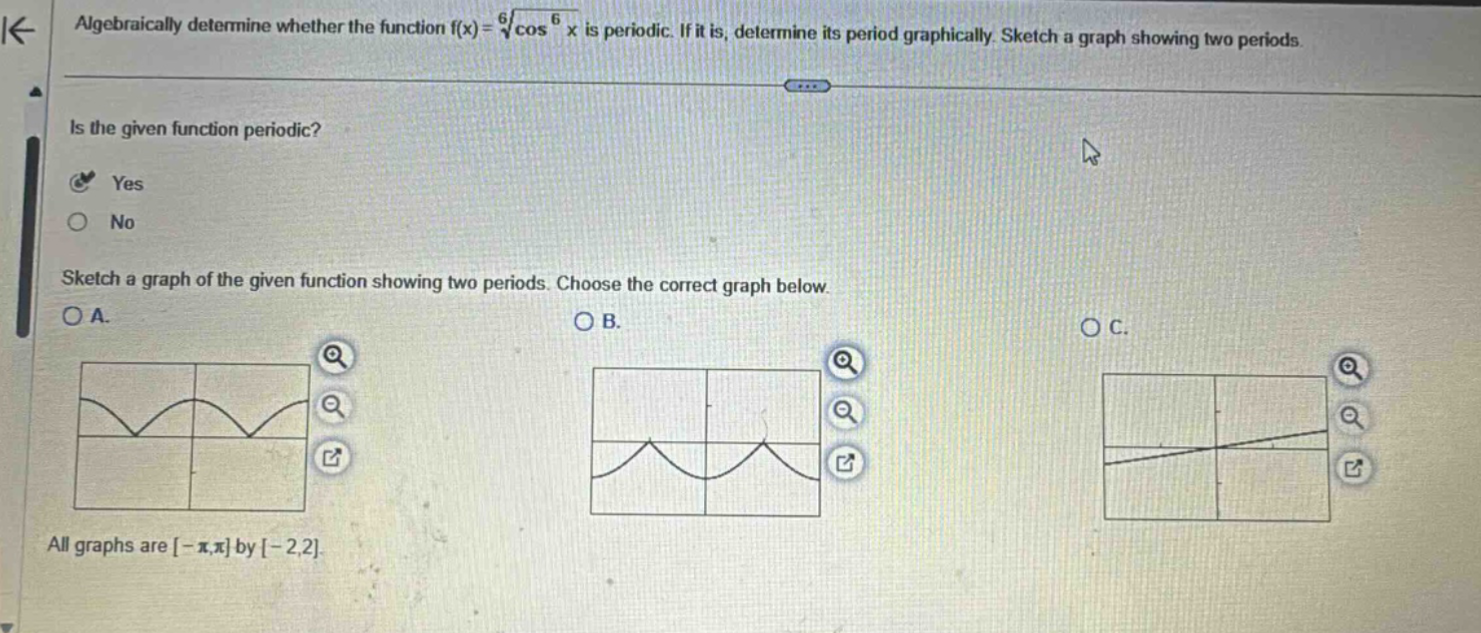
algebraically determine whether the function f(x)=6√cos⁶x is periodic. if it is, determine its period graphically. sketch a graph showing two periods. is the given function periodic? yes no sketch a graph of the given function showing two periods. choose the correct graph below. a. b. c. all graphs are -π,π by -2,2.
Answer
Explanation:
Step1: Recall cosine - function property
We know that the cosine function (y = \cos x) is periodic with period (2\pi), i.e., (\cos(x + 2\pi)=\cos x) for all (x\in R). Let (y = f(x)=\sqrt[6]{\cos^{6}x}=|\cos x|).
Step2: Check periodicity
We want to find (T>0) such that (f(x + T)=f(x)). Since (|\cos(x + 2\pi)|=|\cos x|), the function (y = f(x)) is periodic.
Step3: Determine the period graphically
The period of (y = \cos x) is (2\pi), but for (y = |\cos x|), the period is (\pi). When we graph (y = \cos x), it oscillates between - 1 and 1, and when we take the absolute - value (y = |\cos x|), the negative parts are reflected above the x - axis, and the period is halved.
Step4: Analyze the graph shape
The graph of (y = |\cos x|) starts at (y = 1) when (x = 0), decreases to (y = 0) at (x=\frac{\pi}{2}), and then increases back to (y = 1) at (x=\pi). In the interval ([-\pi,\pi]), it has two full periods of the shape we want.
Answer:
Yes; The correct graph is A.