algebraically determine whether the function f(x)=|sin³x| is periodic. if it is, determine its period…
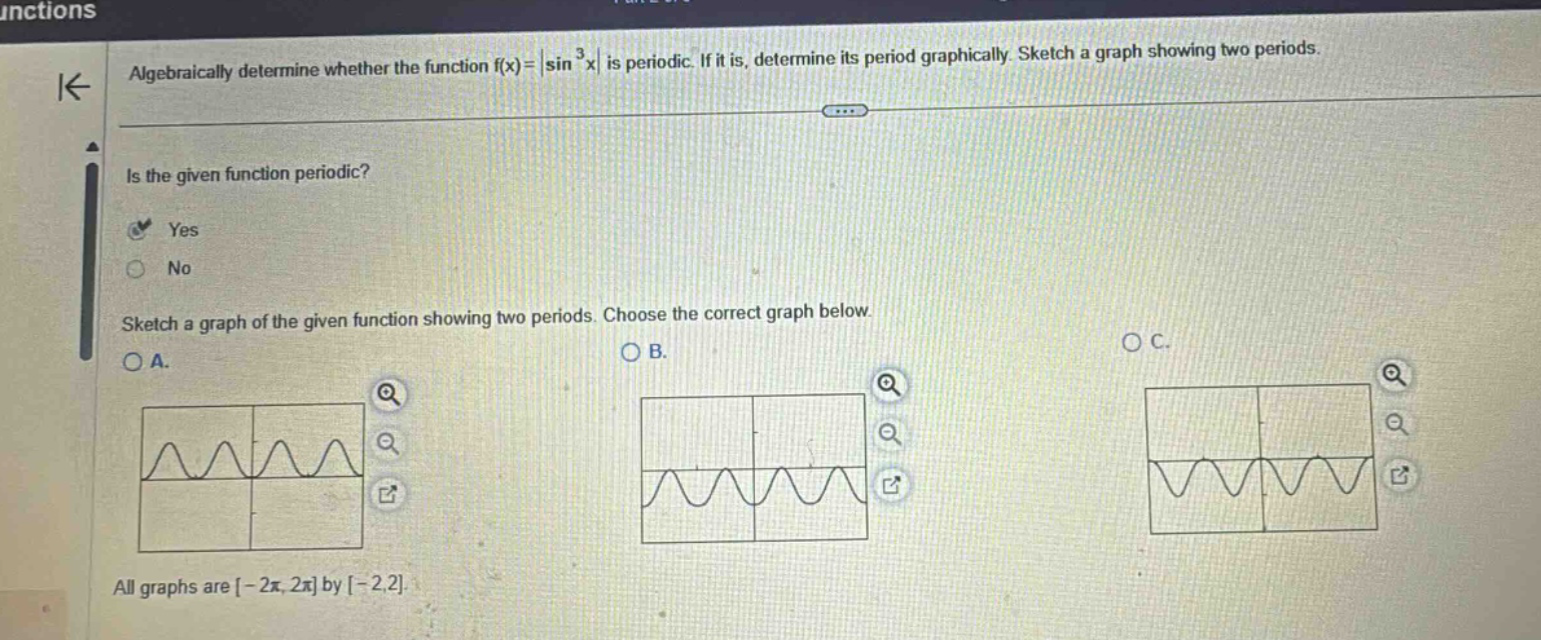
algebraically determine whether the function f(x)=|sin³x| is periodic. if it is, determine its period graphically. sketch a graph showing two periods. is the given function periodic? yes no sketch a graph of the given function showing two periods. choose the correct graph below. a. b. c. all graphs are -2π, 2π by -2,2.
Answer
Explanation:
Step1: Recall periodic - function definition
A function (y = f(x)) is periodic if (f(x + T)=f(x)) for all (x) in the domain of (f) and some positive real - number (T). We know that the function (y = \sin x) has a period of (2\pi), i.e., (\sin(x + 2\pi)=\sin x) for all (x\in R). Let's check (f(x)=\vert\sin^{3}x\vert): [ \begin{align*} f(x + 2\pi)&=\vert\sin^{3}(x + 2\pi)\vert\ &=\vert(\sin(x + 2\pi))^{3}\vert\ &=\vert\sin^{3}x\vert\ &=f(x) \end{align*} ] So, the function (f(x)=\vert\sin^{3}x\vert) is periodic.
Step2: Analyze the graph of (y = \sin^{3}x) and (y=\vert\sin^{3}x\vert)
The function (y = \sin x) has a range of ([- 1,1]), and (y=\sin^{3}x) also has a range of ([-1,1]). When we take the absolute - value (\vert\sin^{3}x\vert), all the negative parts of the graph of (y = \sin^{3}x) are reflected above the (x) - axis. The period of (y = \sin x) is (2\pi). For (y=\sin^{3}x), its period is also (2\pi) since cubing a periodic function with period (2\pi) does not change its period. Taking the absolute - value of (y=\sin^{3}x) does not change the period, so the period of (y = \vert\sin^{3}x\vert) is (\pi) (because (\sin^{3}(x+\pi)=-\sin^{3}x) and (\vert\sin^{3}(x + \pi)\vert=\vert-\sin^{3}x\vert=\vert\sin^{3}x\vert)). The graph of (y = \vert\sin^{3}x\vert) is non - negative, and it has a wave - like shape similar to the graph of (y = \vert\sin x\vert) but with a different amplitude and shape due to the cubing operation. The function (y=\vert\sin^{3}x\vert) starts at (y = 0) when (x = 0), reaches a maximum of (1) at (x=\frac{\pi}{2}+k\pi,k\in Z), and is symmetric about the (y) - axis and has a period of (\pi).
The correct graph is the one where the function is non - negative and has a period of (\pi). Among the options (not shown in detail here but based on the properties of the function), the graph that shows a non - negative wave with a period of (\pi) is the correct one.
Answer:
Yes, and the period is (\pi) (the correct graph is the non - negative one with period (\pi) among the given options).