the amount of water a new tree needs to survive is related to its size. suppose a tree requires (w(g)=30 +…
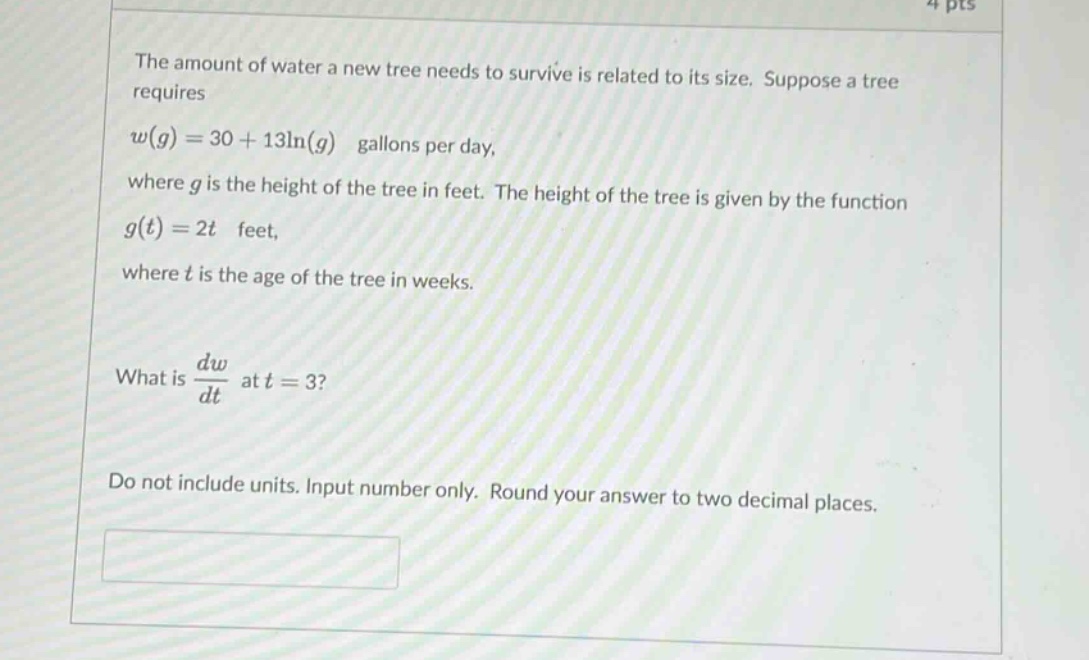
the amount of water a new tree needs to survive is related to its size. suppose a tree requires (w(g)=30 + 13ln(g)) gallons per day, where (g) is the height of the tree in feet. the height of the tree is given by the function (g(t)=2t) feet, where (t) is the age of the tree in weeks. what is (\frac{dw}{dt}) at (t = 3)? do not include units. input number only. round your answer to two decimal places.
Answer
Explanation:
Step1: Apply chain - rule
The chain - rule states that $\frac{dw}{dt}=\frac{dw}{dg}\cdot\frac{dg}{dt}$. First, find $\frac{dw}{dg}$ and $\frac{dg}{dt}$.
Step2: Differentiate $w(g)$ with respect to $g$
Given $w(g)=30 + 13\ln(g)$. Using the derivative formula $\frac{d}{dg}\ln(g)=\frac{1}{g}$ and $\frac{d}{dg}(c)=0$ (where $c$ is a constant), we have $\frac{dw}{dg}=\frac{13}{g}$.
Step3: Differentiate $g(t)$ with respect to $t$
Given $g(t)=2t$. Using the power - rule $\frac{d}{dt}(at)=a$ (where $a$ is a constant), we get $\frac{dg}{dt}=2$.
Step4: Substitute $g(t)$ into $\frac{dw}{dg}$
Since $g = 2t$, then $\frac{dw}{dg}=\frac{13}{2t}$.
Step5: Calculate $\frac{dw}{dt}$
By the chain - rule $\frac{dw}{dt}=\frac{dw}{dg}\cdot\frac{dg}{dt}=\frac{13}{2t}\cdot2=\frac{13}{t}$.
Step6: Evaluate at $t = 3$
Substitute $t = 3$ into $\frac{dw}{dt}$. We have $\frac{dw}{dt}\big|_{t = 3}=\frac{13}{3}\approx4.33$.
Answer:
4.33