what is the amplitude of the cosine function corresponding to the secant function graphed below?\n-2\n-1\n2\n3
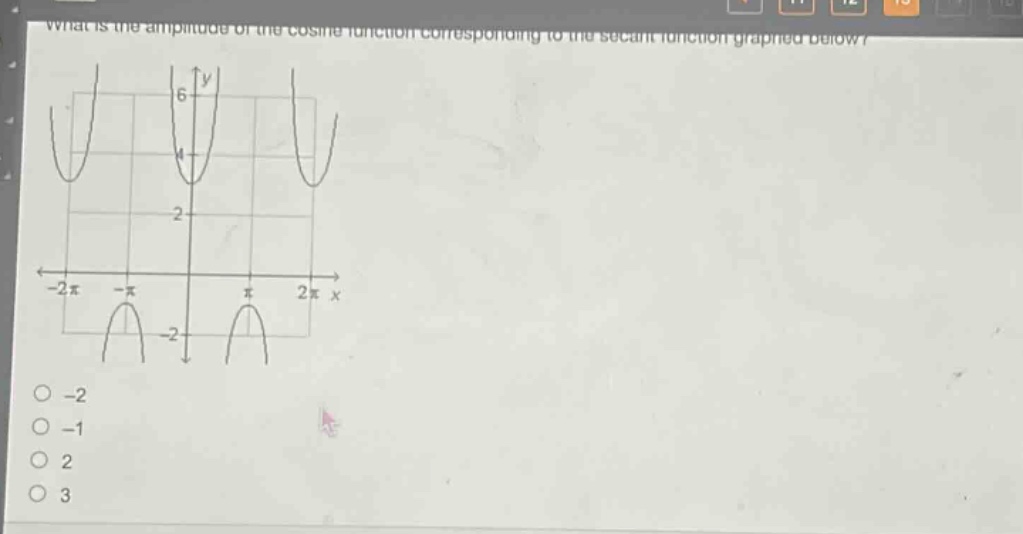
what is the amplitude of the cosine function corresponding to the secant function graphed below?\n-2\n-1\n2\n3
Answer
Explanation:
Step1: Recall secant - cosine relationship
The secant function is $y = \sec(x)=\frac{1}{\cos(x)}$. The vertical asymptotes of $y = \sec(x)$ occur where $\cos(x)=0$. The minimum and maximum values of $y = \sec(x)$ are related to the amplitude of the corresponding cosine function.
Step2: Identify min/max of secant
From the graph, the minimum value of the secant function is $y = 2$ and the maximum value is $y=6$. The general form of a secant function is $y = A\sec(Bx - C)+D$. For the corresponding cosine function $y = A\cos(Bx - C)+D$, the amplitude of the cosine function is related to the vertical distance from the mid - line of the secant function to its extrema. The mid - line of the secant function can be found by $\frac{2 + 6}{2}=4$. The distance from the mid - line to the minimum (or maximum) of the secant function is $|4 - 2|=2$. The amplitude of the corresponding cosine function is the reciprocal of the distance from the mid - line of the secant function to its extrema. Since the secant function $y=\sec(x)=\frac{1}{\cos(x)}$, the amplitude of the cosine function is $\frac{1}{2}$ of the vertical distance between the minimum and maximum values of the secant function relative to its mid - line. In this case, the amplitude of the corresponding cosine function is $2$.
Answer:
2