analyze the function for domain, range, continuity, increasing or decreasing behavior, symmetry…
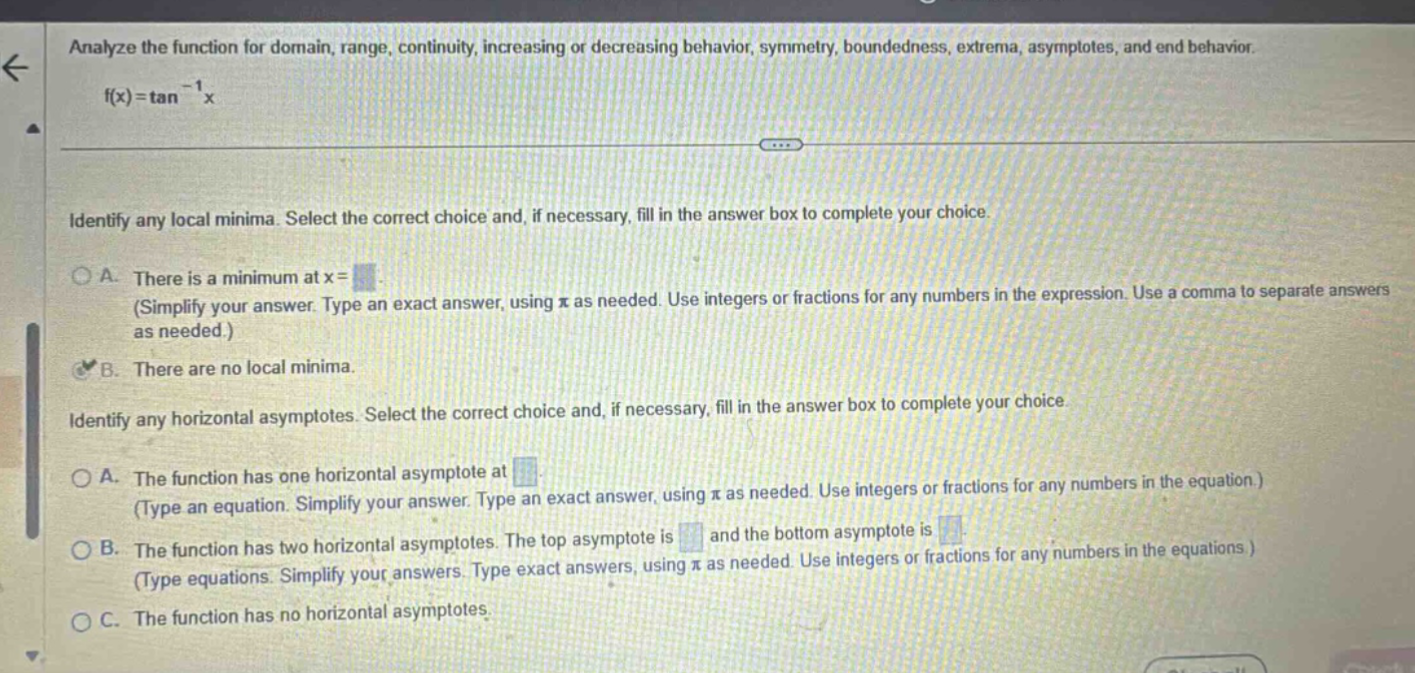
analyze the function for domain, range, continuity, increasing or decreasing behavior, symmetry, boundedness, extrema, asymptotes, and end behavior. f(x)=tan^(-1)x identify any local minima. select the correct choice and, if necessary, fill in the answer box to complete your choice. a. there is a minimum at x= (simplify your answer. type an exact answer, using π as needed. use integers or fractions for any numbers in the expression. use a comma to separate answers as needed.) b. there are no local minima. identify any horizontal asymptotes. select the correct choice and, if necessary, fill in the answer box to complete your choice. a. the function has one horizontal asymptote at (type an equation. simplify your answer. type an exact answer, using π as needed. use integers or fractions for any numbers in the equation.) b. the function has two horizontal asymptotes. the top asymptote is and the bottom asymptote is (type equations. simplify your answers. type exact answers, using π as needed. use integers or fractions for any numbers in the equations ) c. the function has no horizontal asymptotes.
Answer
Answer:
- B. There are no local minima.
- B. The function has two horizontal asymptotes. The top asymptote is $y = \frac{\pi}{2}$ and the bottom asymptote is $y=-\frac{\pi}{2}$.
Explanation:
Step1: Analyze local - minima
The derivative of $y = \arctan(x)$ is $y'=\frac{1}{1 + x^{2}}$. Since $y'=\frac{1}{1 + x^{2}}>0$ for all real - valued $x$ (because $1 + x^{2}>0$ for all $x\in R$), the function is always increasing. A function that is always increasing has no local minima or maxima.
Step2: Analyze horizontal asymptotes
We know that $\lim_{x\rightarrow+\infty}\arctan(x)=\frac{\pi}{2}$ and $\lim_{x\rightarrow-\infty}\arctan(x)=-\frac{\pi}{2}$. So, the function $y = \arctan(x)$ has two horizontal asymptotes $y=\frac{\pi}{2}$ and $y =-\frac{\pi}{2}$.