analyze the function for domain, range, continuity, increasing or decreasing behavior, symmetry…
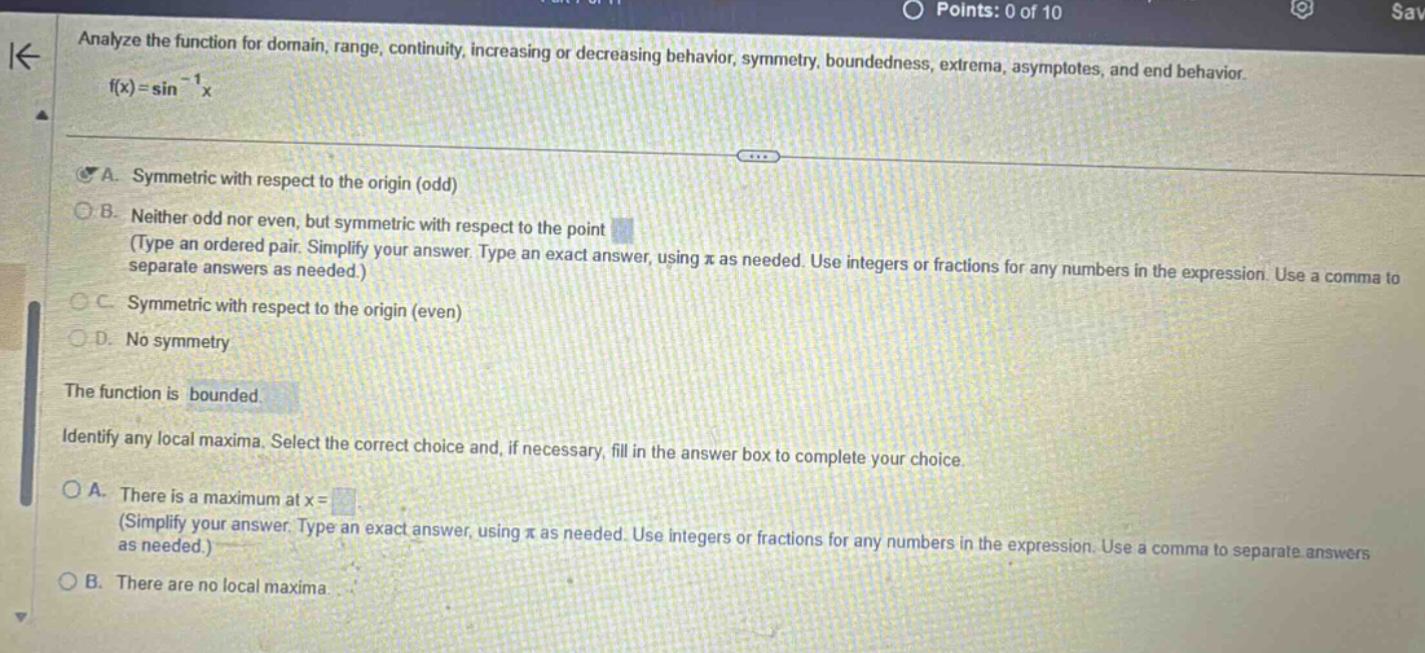
analyze the function for domain, range, continuity, increasing or decreasing behavior, symmetry, boundedness, extrema, asymptotes, and end behavior. f(x)=sin⁻¹x a. symmetric with respect to the origin (odd) b. neither odd nor even, but symmetric with respect to the point (type an ordered pair. simplify your answer. type an exact answer, using π as needed. use integers or fractions for any numbers in the expression. use a comma to separate answers as needed.) c. symmetric with respect to the origin (even) d. no symmetry the function is bounded. identify any local maxima. select the correct choice and, if necessary, fill in the answer box to complete your choice. a. there is a maximum at x = (simplify your answer. type an exact answer, using π as needed. use integers or fractions for any numbers in the expression. use a comma to separate answers as needed.) b. there are no local maxima.
Answer
Answer:
- A. Symmetric with respect to the origin (odd)
- A. There is a maximum at (x = 1)
Explanation:
Step1: Check for symmetry
Recall the property of inverse - sine function. For (y = f(x)=\sin^{- 1}x), (f(-x)=\sin^{-1}(-x)=-\sin^{-1}x=-f(x)). So it is odd and symmetric about the origin.
Step2: Find local maxima
The domain of (y = \sin^{-1}x) is ([-1,1]) and its derivative (y'=\frac{1}{\sqrt{1 - x^{2}}}). The function is increasing on its domain ([-1,1]) (since (y'>0) for (x\in(- 1,1))). So the local maximum occurs at the right - hand end of the domain, i.e., at (x = 1) and (\sin^{-1}(1)=\frac{\pi}{2}).