analyze the functions d(x) and f(x) to determine which has a lesser absolute average rate of change over the…
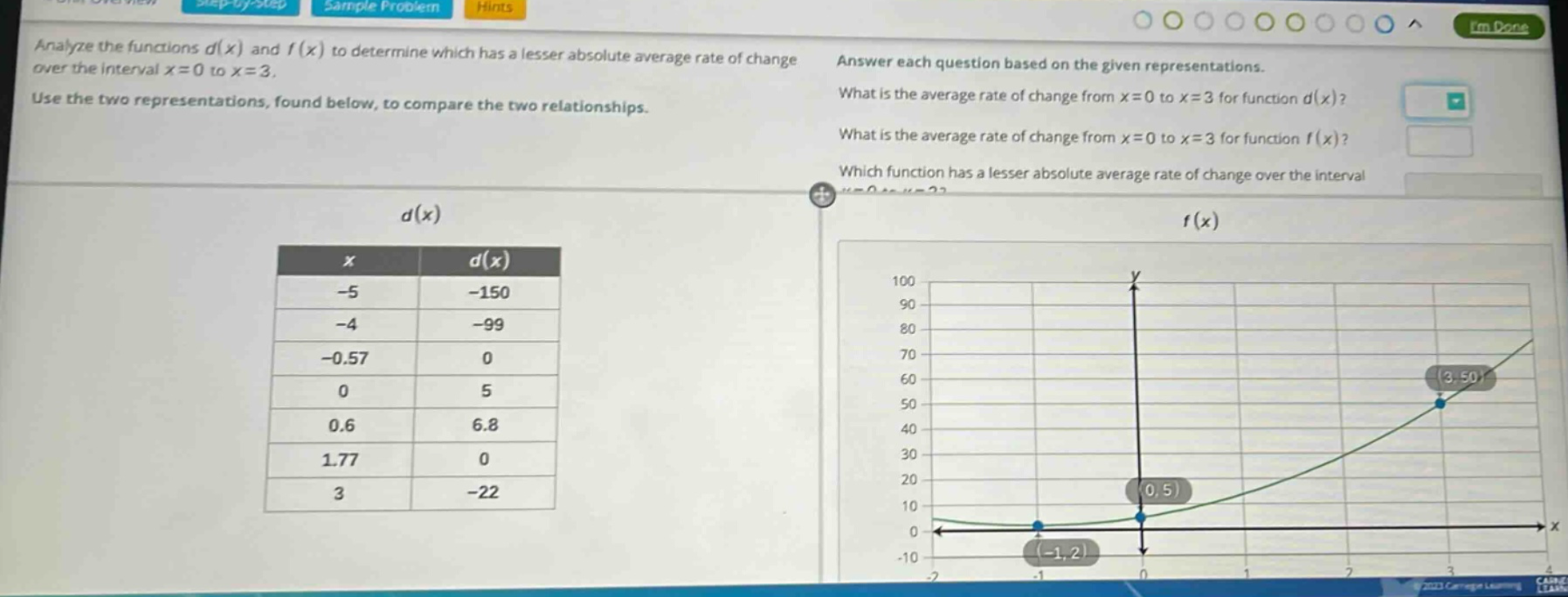
analyze the functions d(x) and f(x) to determine which has a lesser absolute average rate of change over the interval x = 0 to x = 3. use the two representations, found below, to compare the two relationships. answer each question based on the given representations. what is the average rate of change from x = 0 to x = 3 for function d(x)? what is the average rate of change from x = 0 to x = 3 for function f(x)? which function has a lesser absolute average rate of change over the interval x = 0 to x = 3? d(x) x d(x) -5 -150 -4 -99 -0.57 0 0 5 0.6 6.8 1.77 0 3 -22 f(x)
Answer
Explanation:
Step1: Recall average - rate - of - change formula
The average rate of change of a function $y = g(x)$ over the interval $[a,b]$ is $\frac{g(b)-g(a)}{b - a}$.
Step2: Calculate average rate of change for $d(x)$
For $d(x)$ with $a = 0$, $b = 3$, $d(0)=5$ and $d(3)=-22$. The average rate of change is $\frac{d(3)-d(0)}{3 - 0}=\frac{-22 - 5}{3}=\frac{-27}{3}=-9$.
Step3: Calculate average rate of change for $f(x)$
For $f(x)$, from the graph, when $x = 0$, $y = 5$ and when $x = 3$, $y = 50$. The average rate of change is $\frac{f(3)-f(0)}{3 - 0}=\frac{50 - 5}{3}=\frac{45}{3}=15$.
Step4: Compare absolute values
The absolute value of the average rate of change of $d(x)$ is $| - 9|=9$. The absolute value of the average rate of change of $f(x)$ is $|15| = 15$. Since $9<15$, $d(x)$ has a lesser absolute average rate of change.
Answer:
The average rate of change for $d(x)$ is $-9$. The average rate of change for $f(x)$ is $15$. The function $d(x)$ has a lesser absolute average rate of change.