analyze the functions h(x) and b(x) to determine which has a lesser absolute average rate of change over the…
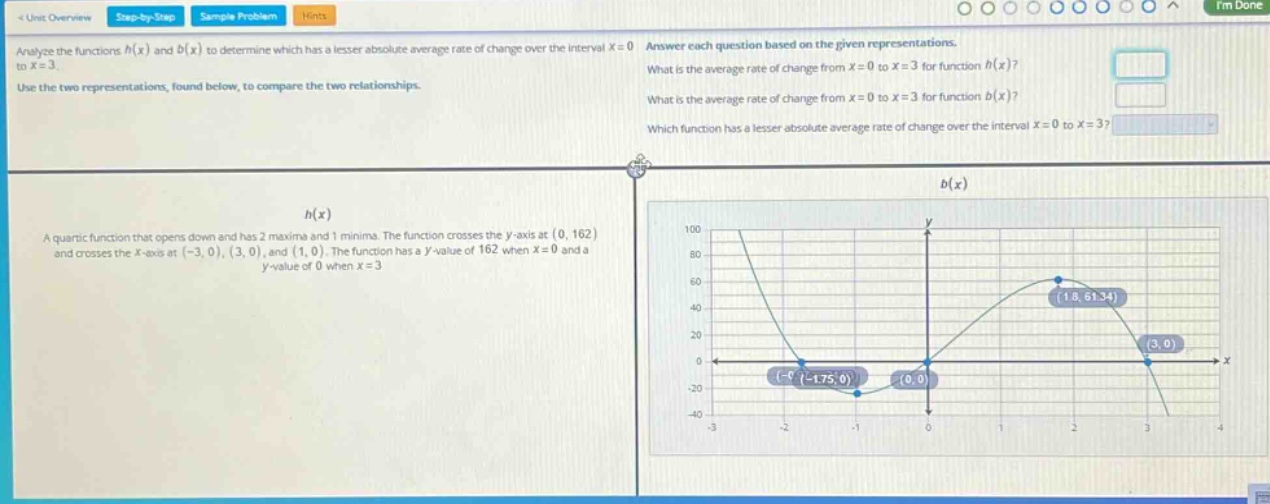
analyze the functions h(x) and b(x) to determine which has a lesser absolute average rate of change over the interval x = 0 to x = 3. use the two representations, found below, to compare the two relationships. answer each question based on the given representations. what is the average rate of change from x = 0 to x = 3 for function h(x)? what is the average rate of change from x = 0 to x = 3 for function b(x)? which function has a lesser absolute average rate of change over the interval x = 0 to x = 3? h(x) a quartic function that opens down and has 2 maxima and 1 minima. the function crosses the y - axis at (0, 162) and crosses the x - axis at (-3, 0), (3, 0), and (1, 0). the function has a y - value of 162 when x = 0 and a y - value of 0 when x = 3
Answer
Explanation:
Step1: Recall average - rate - of - change formula
The average rate of change of a function $y = f(x)$ over the interval $[a,b]$ is given by $\frac{f(b)-f(a)}{b - a}$. For the interval $[0,3]$, $a = 0$ and $b = 3$.
Step2: Calculate average rate of change for $h(x)$
We know that $h(0)=162$ and $h(3)=0$. Using the formula $\frac{h(3)-h(0)}{3 - 0}=\frac{0 - 162}{3}=- 54$. The absolute - value of the average rate of change of $h(x)$ is $| - 54| = 54$.
Step3: Calculate average rate of change for $b(x)$
We have $b(0)=0$ and $b(3)=0$. Using the formula $\frac{b(3)-b(0)}{3 - 0}=\frac{0 - 0}{3}=0$. The absolute - value of the average rate of change of $b(x)$ is $|0| = 0$.
Answer:
What is the average rate of change from $x = 0$ to $x = 3$ for function $h(x)$? - 54 What is the average rate of change from $x = 0$ to $x = 3$ for function $b(x)$? 0 Which function has a lesser absolute average rate of change over the interval $x = 0$ to $x = 3$? $b(x)$