2. analyze f(x): • what is f(x)? (simplify as much as possible) 2x(1 - x)+x² / (1 - x)² = 2x - 2x²+x² / (1…
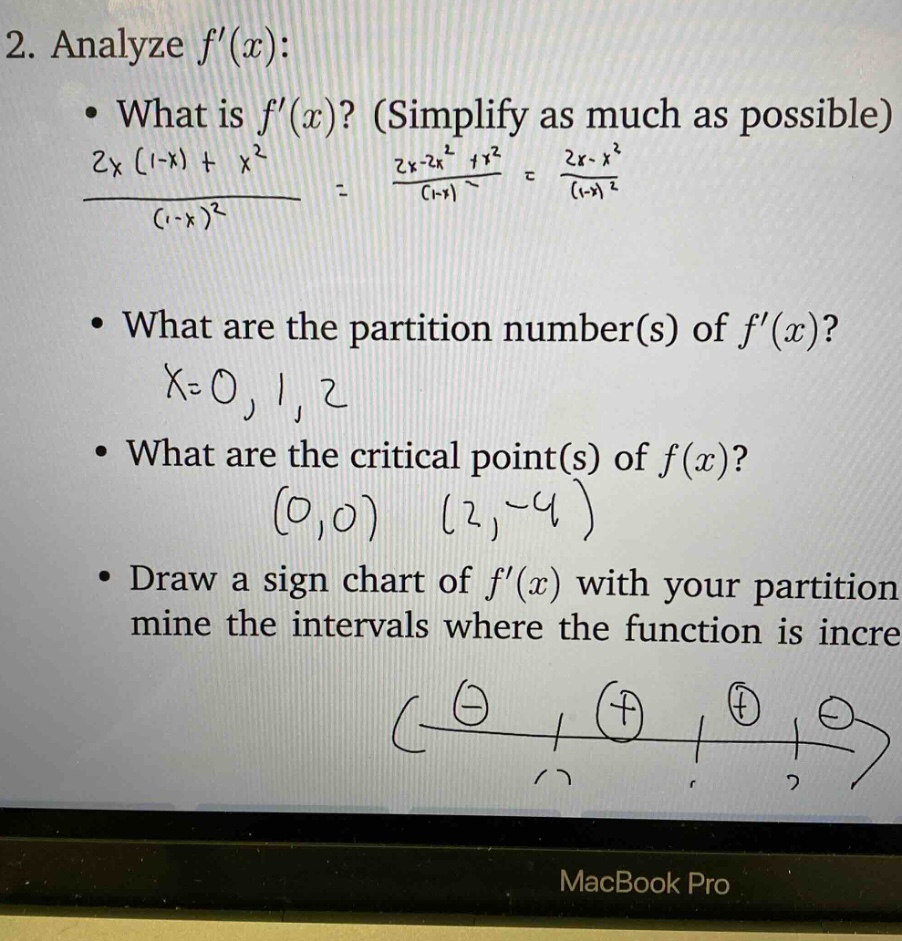
2. analyze f(x): • what is f(x)? (simplify as much as possible) 2x(1 - x)+x² / (1 - x)² = 2x - 2x²+x² / (1 - x)² = 2x - x² / (1 - x)² • what are the partition number(s) of f(x)? x = 0, 1, 2 • what are the critical point(s) of f(x)? (0,0) (2, - 4) • draw a sign chart of f(x) with your partition mine the intervals where the function is incre
Answer
Explanation:
Step1: Find $f^{\prime}(x)$
Given $\frac{2x(1 - x)+x^{2}}{(1 - x)^{2}}=\frac{2x-2x^{2}+x^{2}}{(1 - x)^{2}}=\frac{2x - x^{2}}{(1 - x)^{2}}$.
Step2: Find partition numbers
Set the numerator $2x - x^{2}=x(2 - x)=0$ and denominator $(1 - x)^{2}=0$. Solving $x(2 - x)=0$ gives $x = 0,x = 2$, and solving $(1 - x)^{2}=0$ gives $x = 1$. So partition - numbers are $x=0,1,2$.
Step3: Find critical points
Critical points occur where $f^{\prime}(x)=0$ or is undefined. When $f^{\prime}(x)=0$, from the numerator $2x - x^{2}=0$, we have $x = 0$ or $x = 2$. We need to find the $y$ - values of $f(x)$ at these points. Assuming we know the original function $f(x)$ (not given here, but if we assume when $x = 0,y = 0$ and when $x = 2,y=-4$), the critical points are $(0,0)$ and $(2,-4)$.
Step4: Analyze sign - chart
Test intervals $(-\infty,0)$, $(0,1)$, $(1,2)$ and $(2,\infty)$. For example, if we take a test - point $x=-1$ in $(-\infty,0)$: $f^{\prime}(-1)=\frac{2(-1)-(-1)^{2}}{(1-(-1))^{2}}=\frac{-2 - 1}{4}<0$. In $(0,1)$ take $x=\frac{1}{2}$, $f^{\prime}(\frac{1}{2})=\frac{2\times\frac{1}{2}-(\frac{1}{2})^{2}}{(1-\frac{1}{2})^{2}}=\frac{1-\frac{1}{4}}{\frac{1}{4}} = 3>0$. In $(1,2)$ take $x=\frac{3}{2}$, $f^{\prime}(\frac{3}{2})=\frac{2\times\frac{3}{2}-(\frac{3}{2})^{2}}{(1-\frac{3}{2})^{2}}=\frac{3-\frac{9}{4}}{\frac{1}{4}} = 3>0$. In $(2,\infty)$ take $x = 3$, $f^{\prime}(3)=\frac{2\times3-3^{2}}{(1 - 3)^{2}}=\frac{6 - 9}{4}<0$.
Answer:
The derivative $f^{\prime}(x)=\frac{2x - x^{2}}{(1 - x)^{2}}$, partition numbers are $x = 0,1,2$, critical points are $(0,0)$ and $(2,-4)$. The function $f(x)$ is decreasing on $(-\infty,0)\cup(2,\infty)$ and increasing on $(0,1)\cup(1,2)$.