analyze and sketch a graph of the function. find any intercepts, relative extrema, points of inflection, and…
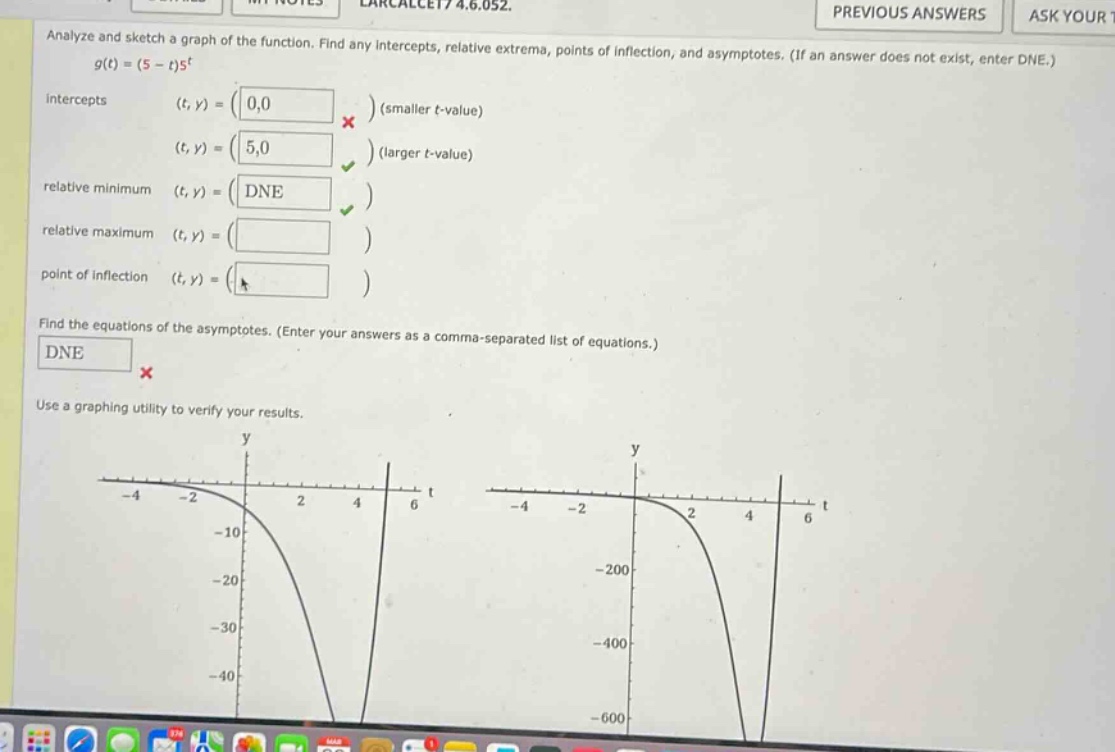
analyze and sketch a graph of the function. find any intercepts, relative extrema, points of inflection, and asymptotes. (if an answer does not exist, enter dne.) g(t)=(5 - t)t^5 intercepts (t,y)=(0,0) (smaller t - value) (t,y)=(5,0) (larger t - value) relative minimum (t,y)=(dne) relative maximum (t,y)=() point of inflection (t,y)=() find the equations of the asymptotes. (enter your answers as a comma - separated list of equations.) dne use a graphing utility to verify your results.
Answer
Explanation:
Step1: Find the first - derivative
First, use the product rule $(uv)^\prime = u^\prime v+uv^\prime$, where $u = 5 - t$ and $v=t^{5}$. $u^\prime=-1$ and $v^\prime = 5t^{4}$. So, $g^\prime(t)=-t^{5}+5(5 - t)t^{4}=t^{4}(-t + 25-5t)=t^{4}(25 - 6t)$. Set $g^\prime(t)=0$, then $t^{4}(25 - 6t)=0$. The solutions are $t = 0$ and $t=\frac{25}{6}\approx4.17$.
Step2: Determine relative extrema
Use the first - derivative test. For $t\lt\frac{25}{6}$ and $t\neq0$, $g^\prime(t)\gt0$ (when $t\lt\frac{25}{6}$, if $t\lt0$, $t^{4}\gt0$ and $25 - 6t\gt0$; if $0\lt t\lt\frac{25}{6}$, $t^{4}\gt0$ and $25 - 6t\gt0$). For $t\gt\frac{25}{6}$, $g^\prime(t)\lt0$. So, the relative maximum occurs at $t=\frac{25}{6}$. $g(\frac{25}{6})=(5-\frac{25}{6})(\frac{25}{6})^{5}=(\frac{30 - 25}{6})(\frac{25}{6})^{5}=\frac{5}{6}\times(\frac{25}{6})^{5}\approx195.3$. The relative maximum is $(\frac{25}{6},\frac{5}{6}\times(\frac{25}{6})^{5})$.
Step3: Find the second - derivative
Use the product rule on $g^\prime(t)=-t^{5}+25t^{4}-5t^{5}=-6t^{5}+25t^{4}$. $g^{\prime\prime}(t)=-30t^{4}+100t^{3}=10t^{3}( - 3t + 10)$. Set $g^{\prime\prime}(t)=0$, then $10t^{3}( - 3t + 10)=0$. The solutions are $t = 0$ and $t=\frac{10}{3}\approx3.33$.
Step4: Determine points of inflection
For $t\lt0$, $g^{\prime\prime}(t)\lt0$. For $0\lt t\lt\frac{10}{3}$, $g^{\prime\prime}(t)\gt0$. For $t\gt\frac{10}{3}$, $g^{\prime\prime}(t)\lt0$. So, the point of inflection is at $t=\frac{10}{3}$. $g(\frac{10}{3})=(5-\frac{10}{3})(\frac{10}{3})^{5}=(\frac{15 - 10}{3})(\frac{10}{3})^{5}=\frac{5}{3}\times(\frac{10}{3})^{5}\approx617.3$. The point of inflection is $(\frac{10}{3},\frac{5}{3}\times(\frac{10}{3})^{5})$.
Step5: Check for asymptotes
Since $g(t)=(5 - t)t^{5}$ is a polynomial function (a product of two polynomials), there are no vertical or horizontal asymptotes.
Answer:
relative maximum: $(\frac{25}{6},\frac{5}{6}\times(\frac{25}{6})^{5})$ point of inflection: $(\frac{10}{3},\frac{5}{3}\times(\frac{10}{3})^{5})$ asymptotes: DNE