analyze and sketch a graph of the function over the given interval. label any intercepts, relative extrema…
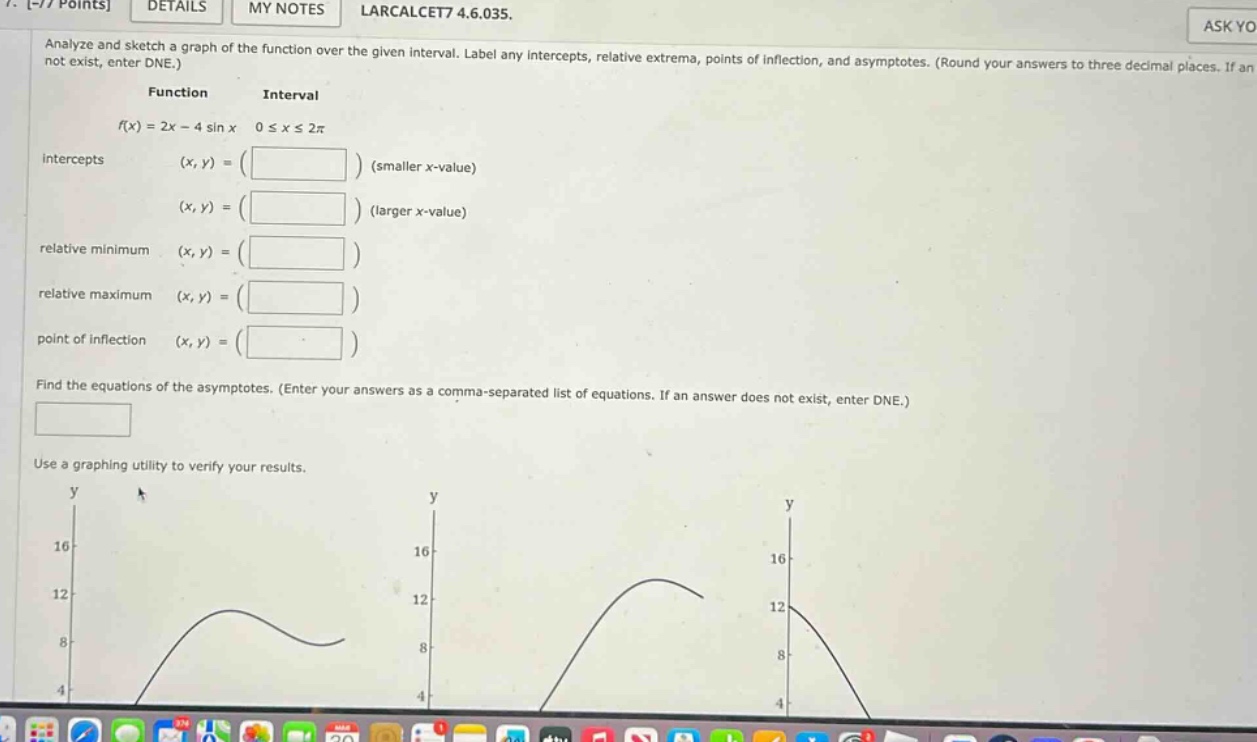
analyze and sketch a graph of the function over the given interval. label any intercepts, relative extrema, points of inflection, and asymptotes. (round your answers to three decimal places. if an not exist, enter dne.) function interval f(x)=2x - 4 sin x 0 ≤ x ≤ 2π intercepts (x, y)=( ) (smaller x - value) (x, y)=( ) (larger x - value) relative minimum (x, y)=( ) relative maximum (x, y)=( ) point of inflection (x, y)=( ) find the equations of the asymptotes. (enter your answers as a comma - separated list of equations. if an answer does not exist, enter dne.) use a graphing utility to verify your results.
Answer
Explanation:
Step1: Find x - intercepts
Set (y = f(x)=2x - 4\sin x=0). Since (2x - 4\sin x = 0), we can't solve it algebraically easily. Using a graphing - utility or numerical methods (e.g., Newton - Raphson method), in the interval (0\leq x\leq2\pi), when (x = 0), (y=2\times0 - 4\sin(0)=0). For other roots, we note that the function (y = 2x-4\sin x) is continuous. Another root in the interval ([0,2\pi]) is approximately (x\approx1.935). (y = 2\times1.935-4\sin(1.935)\approx0).
Step2: Find the first - derivative
Differentiate (y = f(x)=2x - 4\sin x) using the sum rule and the derivative formulas. (y^\prime=f^\prime(x)=2 - 4\cos x).
Step3: Find critical points
Set (y^\prime = 0), so (2 - 4\cos x=0). Then (\cos x=\frac{1}{2}). In the interval (0\leq x\leq2\pi), (x=\frac{\pi}{3}) and (x = \frac{5\pi}{3}).
Step4: Determine relative extrema
Find the second - derivative (y^{\prime\prime}=f^{\prime\prime}(x)=4\sin x). When (x=\frac{\pi}{3}), (y^{\prime\prime}( \frac{\pi}{3})=4\sin(\frac{\pi}{3}) = 2\sqrt{3}>0), so there is a relative minimum at (x=\frac{\pi}{3}). (y(\frac{\pi}{3})=2\times\frac{\pi}{3}-4\sin(\frac{\pi}{3})=\frac{2\pi}{3}-2\sqrt{3}\approx - 1.155). When (x=\frac{5\pi}{3}), (y^{\prime\prime}(\frac{5\pi}{3})=4\sin(\frac{5\pi}{3})=-2\sqrt{3}<0), so there is a relative maximum at (x = \frac{5\pi}{3}). (y(\frac{5\pi}{3})=2\times\frac{5\pi}{3}-4\sin(\frac{5\pi}{3})=\frac{10\pi}{3}+2\sqrt{3}\approx11.085).
Step5: Find points of inflection
Set (y^{\prime\prime}=4\sin x = 0). In the interval (0\leq x\leq2\pi), (x = 0,\pi,2\pi). But we usually consider non - endpoint points of inflection in an open interval. So the point of inflection in the open interval ((0,2\pi)) is (x=\pi), and (y(\pi)=2\pi-4\sin(\pi)=2\pi\approx6.283).
Step6: Find asymptotes
Since (f(x)=2x - 4\sin x) is a continuous function on the closed interval ([0,2\pi]), there are no vertical or horizontal asymptotes. So the equation of the asymptotes is DNE.
Answer:
Intercepts: ((x,y)=(0,0)) (smaller (x) - value), ((x,y)=(1.935,0)) (larger (x) - value) Relative minimum: ((x,y)=(\frac{\pi}{3},-1.155)) Relative maximum: ((x,y)=(\frac{5\pi}{3},11.085)) Point of inflection: ((x,y)=(\pi,6.283)) Asymptotes: DNE