analyzing an interval\nwhich table shows a function that is decreasing only over the interval (-1, 1)?\n| x…
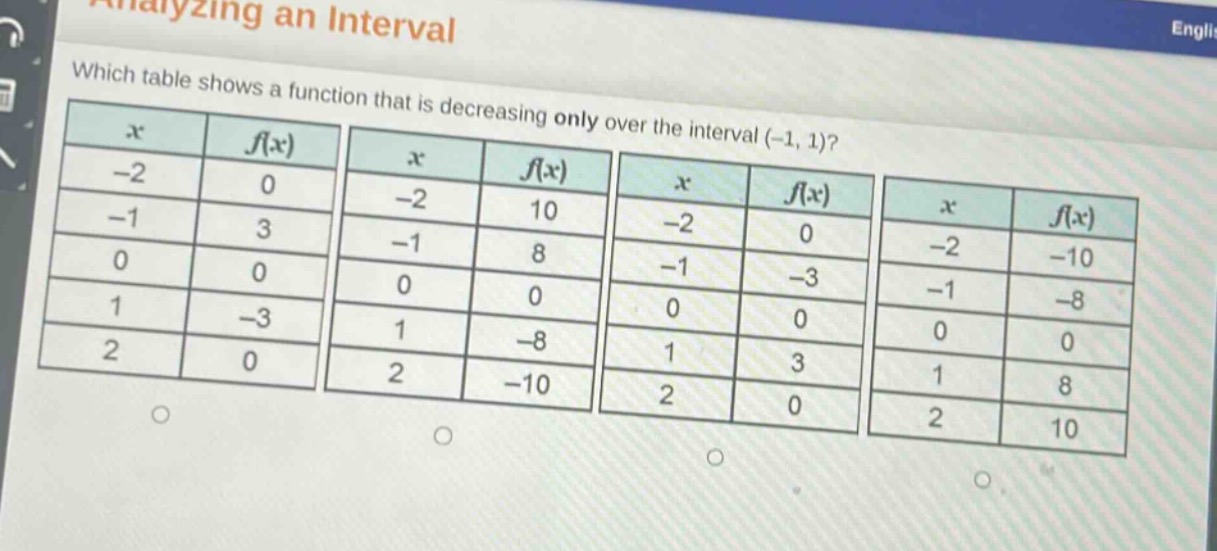
analyzing an interval\nwhich table shows a function that is decreasing only over the interval (-1, 1)?\n| x | f(x) | | x | f(x) | | x | f(x) | | x | f(x) |\n| -2 | 0 | | -2 | 10 | | -2 | 0 | | -2 | -10 |\n| -1 | 3 | | -1 | 8 | | -1 | -3 | | -1 | -8 |\n| 0 | 0 | | 0 | 0 | | 0 | 0 | | 0 | 0 |\n| 1 | -3 | | 1 | -8 | | 1 | 3 | | 1 | 8 |\n| 2 | 0 | | 2 | -10 | | 2 | 0 | | 2 | 10 |
Answer
Explanation:
Step1: Recall decreasing - function definition
A function $y = f(x)$ is decreasing on an interval if for any two values $x_1$ and $x_2$ in the interval with $x_1<x_2$, we have $f(x_1)>f(x_2)$.
Step2: Check the first table
For $x$ values in the interval $(-1,1)$ (i.e., $x = 0$), when $x=-1,f(-1) = 3$ and when $x = 0,f(0)=0$ and when $x = 1,f(1)=-3$. Also, check outside the interval: for $x=-2,f(-2)=0$ and for $x = 2,f(2)=0$. The function is decreasing on $(-1,1)$ and not decreasing elsewhere in the given $x$ - values.
Step3: Check the second table
For $x\in(-1,1)$: when $x=-1,f(-1)=8$ and when $x = 0,f(0)=0$ and when $x = 1,f(1)=-8$. But for $x=-2,f(-2)=10$ and $f(-2)>f(-1)$, so it is decreasing before $x=-1$ too.
Step4: Check the third table
For $x\in(-1,1)$: when $x=-1,f(-1)=-3$ and when $x = 0,f(0)=0$ and when $x = 1,f(1)=3$. The function is increasing on $(-1,1)$.
Step5: Check the fourth table
For $x\in(-1,1)$: when $x=-1,f(-1)=-8$ and when $x = 0,f(0)=0$ and when $x = 1,f(1)=8$. The function is increasing on $(-1,1)$.
Answer:
The first table (with $x$ values - 2, - 1, 0, 1, 2 and $f(x)$ values 0, 3, 0, - 3, 0)